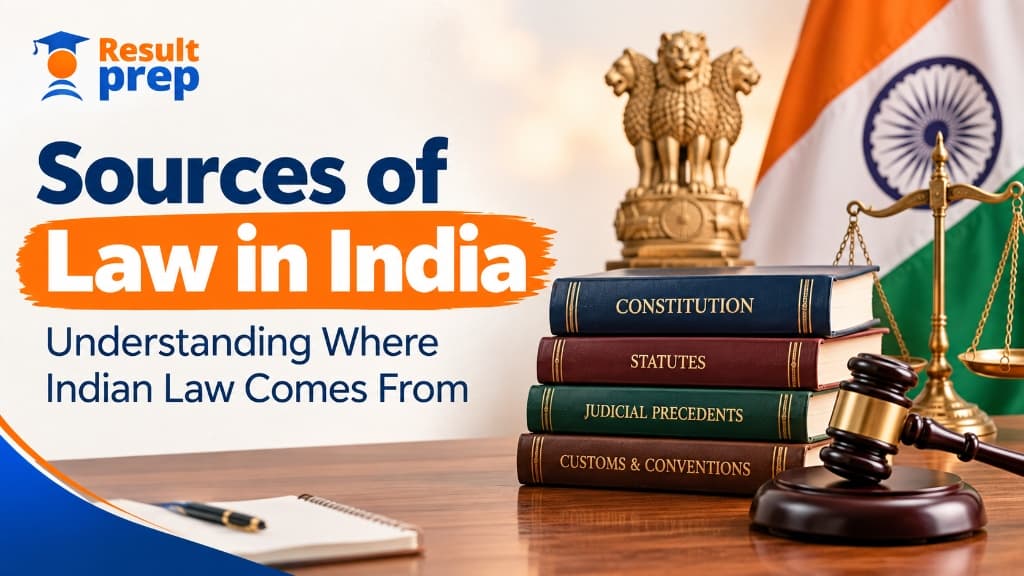
Sources of Law in India: Understanding Where Indian Law Comes From
An in-depth exploration of the evolution of law, its meaning, objectives, sources, classification, and the foundational framework of the Indian legal system.
Part I: Meaning, Evolution, and Primary Sources of Law
Introduction
Every legal system derives its authority from recognised sources that determine how laws are created, interpreted, and enforced. In India, the legal framework is built upon a combination of constitutional principles, legislative enactments, judicial decisions, customs, and delegated legislation. Together, these sources provide the foundation upon which the administration of justice rests and ensure that legal rules evolve with the changing needs of society.
The Indian legal system is unique because it combines elements of English common law with indigenous legal traditions, constitutional values, and statutory enactments. While the Constitution of India is the supreme law of the land, legislation enacted by Parliament and State Legislatures, judicial precedents, long-established customs, and administrative regulations all contribute to the development of Indian law.
Understanding the sources of law is essential for law students, legal practitioners, civil service aspirants, and every citizen seeking to appreciate how legal rules originate and become enforceable. This article examines the principal sources of Indian law, their constitutional basis, and their continuing relevance in modern governance.
What Are the Sources of Law?
The term "sources of law" refers to the origins from which legal rules derive their authority and legitimacy. In other words, sources of law answer the question: Where does law come from?
Different legal systems recognise different sources depending upon their constitutional structure and historical development. In India, the principal sources of law include:
- The Constitution of India
- Legislation
- Judicial Precedents
- Customs
- Delegated Legislation
Each source performs a distinct function within the legal system and collectively contributes to the administration of justice.
Evolution of the Indian Legal System
The Indian legal system has evolved over several centuries through the interaction of ancient customs, religious texts, colonial legislation, judicial precedents, and constitutional governance.
In ancient India, legal principles were primarily derived from Dharma, religious scriptures, customs, and local traditions. Hindu jurisprudence recognised Shruti (the Vedas) and Smriti (texts such as Manusmriti and Yajnavalkya Smriti) as important sources of law. Different communities also followed customary practices governing marriage, inheritance, property, and social obligations.
During the medieval period, Islamic law significantly influenced legal administration in many parts of the country, particularly in matters relating to personal law and criminal justice.
The British colonial administration introduced English common law principles and enacted several landmark statutes, many of which continue to operate even today. Important enactments such as the Indian Contract Act, 1872, the Transfer of Property Act, 1882, and the Code of Civil Procedure, 1908 remain integral parts of India's legal framework.
Following independence, the adoption of the Constitution of India in 1950 transformed the legal system by establishing constitutional supremacy, guaranteeing Fundamental Rights, and creating an independent judiciary. Today, Indian law represents a harmonious blend of constitutional values, legislative enactments, judicial interpretation, and long-standing legal traditions.
The Constitution: The Supreme Source of Law
The Constitution of India is the supreme law of the land and forms the foundation of the entire legal system. Every law enacted by Parliament or a State Legislature derives its validity from the Constitution.
Adopted on 26 November 1949 and brought into force on 26 January 1950, the Constitution establishes the structure of government, distributes legislative powers, guarantees Fundamental Rights, prescribes Directive Principles of State Policy, and defines the powers of constitutional institutions.
Any legislation inconsistent with constitutional provisions may be declared unconstitutional by the judiciary through the power of judicial review.
The Constitution also provides for:
- Fundamental Rights (Part III)
- Directive Principles of State Policy (Part IV)
- Fundamental Duties (Part IVA)
- Distribution of legislative powers between the Union and the States
- Independence of the judiciary
- Emergency provisions
- Amendment procedure
Because every legal authority ultimately derives its power from the Constitution, it occupies the highest position among all sources of law.
Legislation
In modern democratic societies, legislation is the most important and widely used source of law.
Legislation refers to laws formally enacted by competent legislative bodies.
In India, legislative power is exercised by:
- Parliament;
- State Legislatures; and
- Union Territory Legislatures (where applicable).
The Constitution distributes legislative powers through the Seventh Schedule, which contains:
- Union List
- State List
- Concurrent List
Parliament possesses exclusive authority over subjects in the Union List, including defence, banking, foreign affairs, citizenship, and telecommunications.
State Legislatures enact laws concerning matters such as public health, police, agriculture, and local government.
Subjects included in the Concurrent List may be legislated upon by both Parliament and State Legislatures. In the event of inconsistency, parliamentary legislation ordinarily prevails, subject to constitutional provisions.
Legislation has become the dominant source of law because it provides certainty, democratic legitimacy, and the ability to address complex social and economic issues through comprehensive statutory regulation.
Examples include:
- Indian Contract Act, 1872
- Companies Act, 2013
- Right to Information Act, 2005
- Consumer Protection Act, 2019
- Environment (Protection) Act, 1986
Judicial Precedents
Another important source of Indian law is judicial precedent, often referred to as case law.
Indian courts follow the doctrine of stare decisis, which means that similar cases should ordinarily be decided similarly.
The Constitution itself recognises this principle. Article 141 provides:
"The law declared by the Supreme Court shall be binding on all courts within the territory of India."
Consequently, judgments delivered by the Supreme Court become binding precedents for all subordinate courts. Similarly, High Court decisions are binding upon subordinate courts within their respective jurisdictions.
Judicial precedents perform several important functions:
- ensuring uniformity in legal interpretation;
- filling gaps where legislation is silent;
- adapting legal principles to changing social conditions;
- protecting constitutional rights.
Many important legal doctrines have evolved primarily through judicial decisions rather than legislation. Examples include:
- Basic Structure Doctrine;
- Absolute Liability;
- Right to Privacy;
- Public Interest Litigation;
- Environmental Principles such as the Polluter Pays Principle.
Judicial interpretation therefore remains an indispensable source of Indian law.
Customs as a Source of Law
Long before organised governments emerged, communities regulated human conduct through customs and traditions.
A custom may be defined as a long-established practice consistently followed by members of a community who regard it as legally obligatory.
Indian courts continue to recognise customs provided they satisfy certain essential conditions. A valid custom must generally be:
- ancient;
- continuous;
- certain;
- reasonable;
- not opposed to morality;
- not contrary to statutory law or public policy.
Customary law continues to play an important role in several areas, particularly personal laws governing marriage, inheritance, succession, and adoption among different communities.
However, where a valid statute expressly governs the subject matter, statutory provisions ordinarily prevail over inconsistent customs.
Delegated Legislation
Modern governance requires detailed regulations covering numerous technical and administrative matters.
Since legislatures cannot themselves enact detailed rules governing every aspect of administration, they frequently delegate limited legislative powers to executive authorities.
Rules, regulations, notifications, bye-laws, schemes, and circulars framed under statutory authority are collectively known as Delegated Legislation or Subordinate Legislation.
Examples include regulations issued by:
- Central Government;
- State Governments;
- Municipal Corporations;
- Development Authorities;
- Regulatory Bodies;
- Local Self-Government Institutions.
Delegated legislation enables governments to respond quickly to changing administrative requirements while remaining subject to judicial review.
However, delegated legislation cannot exceed the authority granted by the parent statute. Courts possess the power to invalidate delegated legislation that is arbitrary, unconstitutional, or inconsistent with the enabling Act.
Importance of Multiple Sources of Law
The existence of multiple sources strengthens the legal system by ensuring flexibility and stability.
The Constitution provides the foundational framework. Legislation addresses contemporary social and economic needs. Judicial precedents ensure consistency while adapting the law to new situations. Customs preserve long-established social practices. Delegated legislation facilitates efficient governance by addressing technical details that legislatures cannot reasonably regulate through primary legislation.
Together, these sources create a dynamic legal system capable of responding to the changing needs of a modern democratic society.
Part II: Law-Making Process, Role of the Judiciary, and Law Reform in India
In Part I, we examined the principal sources of Indian law, namely the Constitution, legislation, judicial precedents, customs, and delegated legislation. While these sources explain where law originates, it is equally important to understand how laws are made, interpreted, and enforced. India's constitutional framework carefully distributes legislative powers between the Union and the States while entrusting the judiciary with the responsibility of interpreting laws and safeguarding the Constitution. This part discusses the legislative process, the role of Parliament and State Legislatures, the jurisdiction of constitutional courts, and the contribution of the Law Commission to legal reform.
How Are Laws Made in India?
India follows a parliamentary system of democracy, where laws are enacted through a constitutional process involving the Legislature, the Executive, and, to a limited extent, the Judiciary through interpretation.
The authority to make laws flows directly from the Constitution of India, which distributes legislative powers between Parliament and the State Legislatures. Every law enacted in India must conform to constitutional provisions and cannot violate Fundamental Rights or the basic structure of the Constitution.
The legislative process generally involves the following stages:
- Introduction of a Bill.
- Debate and discussion in the Legislature.
- Approval by both Houses (where applicable).
- Assent of the President or Governor.
- Publication in the Official Gazette.
- Commencement on the date specified in the Act.
Only after completing these constitutional formalities does a Bill become an enforceable law.
Parliament: The Supreme Legislative Authority
Parliament is the highest legislative body of the Union and derives its powers from Articles 79 to 122 of the Constitution.
It consists of:
- The President of India,
- The Lok Sabha (House of the People), and
- The Rajya Sabha (Council of States).
Parliament possesses exclusive legislative authority over subjects mentioned in the Union List, such as:
- Defence
- Foreign Affairs
- Banking
- Currency
- Citizenship
- Telecommunications
- Atomic Energy
- Aviation
Parliament may also legislate on matters contained in the Concurrent List and, in certain exceptional situations provided under the Constitution, even on State subjects.
Apart from law-making, Parliament performs several other important functions, including:
- Financial control through the Budget.
- Executive accountability.
- Constitutional amendments.
- Deliberation on matters of national importance.
Its central role ensures democratic legitimacy in the law-making process.
State Legislatures
India follows a federal structure in which States possess independent legislative authority over subjects assigned to them by the Constitution.
State Legislatures enact laws relating to matters contained in the State List, including:
- Police
- Public Order
- Agriculture
- Local Government
- Public Health
- Markets and Fairs
- Fisheries
- Land Revenue
Some States have a bicameral legislature consisting of a Legislative Assembly and a Legislative Council, while most States have only a Legislative Assembly.
State legislation plays a vital role in addressing local administrative, economic, and social concerns that vary across different regions of the country.
Distribution of Legislative Powers
One of the defining features of the Indian Constitution is the distribution of legislative powers through the Seventh Schedule, which contains three legislative lists.
Union List
The Union List contains matters of national importance requiring uniform regulation throughout India. Only Parliament can legislate on these subjects.
Examples include:
- Defence
- Foreign Affairs
- Railways
- Currency
- Income Tax
- Citizenship
- National Highways
State List
The State List contains subjects primarily concerning regional governance. Only State Legislatures ordinarily possess legislative competence over these matters.
Examples include:
- Police
- Agriculture
- Public Health
- Local Government
- Markets
- Land
- Fisheries
Concurrent List
The Concurrent List contains subjects upon which both Parliament and State Legislatures may enact laws.
Examples include:
- Criminal Law
- Marriage and Divorce
- Education
- Labour Welfare
- Forests
- Adoption
- Electricity
Where a State law conflicts with a Parliamentary law on a Concurrent List subject, the Parliamentary law generally prevails to the extent of inconsistency, unless the Constitution provides otherwise. This constitutional arrangement maintains a balance between national unity and regional autonomy.
Acts and Ordinances
The principal forms of legislation in India are Acts and Ordinances.
Acts
A Bill introduced in Parliament or a State Legislature becomes an Act after being passed by the Legislature and receiving the assent of the President or the Governor, as the case may be. Acts constitute permanent legislation unless subsequently amended or repealed.
Examples include:
- Companies Act, 2013
- Consumer Protection Act, 2019
- Right to Information Act, 2005
- Environment (Protection) Act, 1986
Ordinances
The Constitution empowers the President (Article 123) and the Governor (Article 213) to promulgate Ordinances when:
- the Legislature is not in session; and
- immediate legislative action becomes necessary.
An Ordinance possesses the same force as an Act but is temporary in nature. It must be placed before the appropriate Legislature after it reassembles and ceases to operate if not approved within the constitutionally prescribed period.
The ordinance-making power is intended for exceptional situations and cannot ordinarily substitute the regular legislative process.
Role of the President and the Governor
Although legislative power primarily rests with Parliament and the State Legislatures, the President and Governors perform important constitutional functions in the legislative process.
The President:
- summons and prorogues Parliament,
- gives assent to Bills,
- may return certain Bills for reconsideration,
- promulgates Ordinances under Article 123.
Similarly, the Governor:
- gives assent to State Bills,
- may reserve Bills for the consideration of the President,
- promulgates Ordinances under Article 213 when the State Legislature is not in session.
These constitutional functions ensure proper checks and balances within the legislative framework.
The Supreme Court of India
The Supreme Court of India is the highest constitutional court and the final interpreter of the Constitution. Established under Article 124, it safeguards constitutional supremacy, protects Fundamental Rights, and ensures uniform interpretation of law throughout the country.
The Supreme Court exercises three principal jurisdictions:
Original Jurisdiction
Under Article 131, the Supreme Court directly hears disputes between:
- the Union and one or more States,
- two or more States.
It also entertains petitions for enforcement of Fundamental Rights under Article 32, often described by Dr. B. R. Ambedkar as the "heart and soul" of the Constitution.
Appellate Jurisdiction
The Supreme Court hears appeals against judgments of High Courts in civil, criminal, and constitutional matters. Additionally, under Article 136, it possesses the extraordinary power to grant Special Leave to Appeal (SLP) against decisions of almost every court or tribunal in India, except those constituted under military law.
Advisory Jurisdiction
Under Article 143, the President of India may seek the advisory opinion of the Supreme Court on questions of law or matters of public importance. Although advisory opinions are not binding in the same manner as judicial decisions, they carry great constitutional significance.
High Courts
Every State has a High Court established under Article 214, while Parliament may establish a common High Court for two or more States under Article 231.
High Courts exercise:
- Original Jurisdiction,
- Appellate Jurisdiction,
- Supervisory Jurisdiction,
- Writ Jurisdiction under Article 226.
One important distinction is that the writ jurisdiction of High Courts under Article 226 is wider than that of the Supreme Court under Article 32 because High Courts may issue writs not only for enforcement of Fundamental Rights but also for "any other purpose."
High Courts also supervise subordinate courts and tribunals functioning within their territorial jurisdiction under Article 227.
Judicial Review and Judicial Precedent
One of the most important functions of constitutional courts is Judicial Review. Judicial review enables courts to examine whether laws enacted by Parliament or State Legislatures conform to the Constitution. Where legislation violates constitutional provisions or Fundamental Rights, courts may declare it unconstitutional.
The Supreme Court also develops law through judicial precedents. Under Article 141, the law declared by the Supreme Court is binding upon all courts throughout India.
This doctrine promotes:
- certainty,
- consistency,
- equality before law,
- uniform interpretation.
Judicial precedent therefore constitutes one of the most dynamic sources of Indian law.
Law Commission of India
Law is never static. As society evolves, legal reforms become necessary to address emerging social, economic, technological, and constitutional challenges.
The Law Commission of India has historically played a significant advisory role in this process. Constituted from time to time by the Central Government, it undertakes research, reviews existing laws, recommends reforms, identifies obsolete legislation, and suggests new legal frameworks where required. Its reports have contributed to significant legislative changes in areas such as criminal law, family law, arbitration, commercial law, and judicial administration.
The Commission's recommendations are not binding, but they often serve as the basis for legislative reform and policy development.
Conclusion to Part II
The Indian law-making process reflects a careful constitutional balance between democratic legislation and judicial oversight. Parliament and State Legislatures enact laws within their respective fields, while the President and Governors perform important constitutional functions in the legislative process. The Supreme Court and High Courts ensure that all laws conform to the Constitution and protect the rights of citizens through judicial review and constitutional interpretation. Institutions such as the Law Commission further strengthen the legal system by recommending reforms that keep Indian law responsive to changing societal needs.
Part III: Ancient Sources, Personal Laws, Important Statutes, and Contemporary Relevance
In the previous parts, we explored the principal sources of Indian law, the legislative process, the constitutional distribution of legislative powers, and the role of the judiciary in interpreting and enforcing the law. To fully appreciate the Indian legal system, it is equally important to understand its historical roots and the diverse body of laws governing different aspects of modern society. This final part examines the ancient foundations of Indian law, the concept of personal laws, important statutory enactments, and the continuing evolution of the legal system in response to contemporary challenges.
Ancient Sources of Indian Law
Long before the establishment of modern legislatures and constitutional governance, India possessed a highly developed legal tradition. Ancient Indian jurisprudence was founded upon the concept of Dharma, a comprehensive idea encompassing law, morality, justice, ethics, and social duty. Unlike modern legal systems, where law and morality are generally treated as separate concepts, ancient Indian jurisprudence viewed them as inseparable components of social order.
The earliest sources of Hindu law were the Shrutis, comprising the four Vedas. Although primarily religious texts, they laid down philosophical principles that influenced legal and social conduct. Over time, these principles were elaborated through the Smritis, including the Manusmriti, Yajnavalkya Smriti, and Narada Smriti, which addressed matters relating to family relationships, succession, contracts, property, punishments, and governance.
Legal scholars such as Manu, Yajnavalkya, Narada, and Gautama made significant contributions to ancient Indian jurisprudence. During the medieval period, Hindu law developed into two principal schools:
- Mitakshara, authored by Vijnaneshwara, which became applicable in most parts of India; and
- Dayabhaga, authored by Jimutvahana, which was followed mainly in Bengal and parts of northeastern India.
Although modern India is governed primarily by statutory law, several concepts originating in ancient jurisprudence continue to influence personal laws and judicial interpretation.
Personal Laws in India
India is a multicultural and multi-religious nation, and its legal system recognises different personal laws governing matters such as marriage, divorce, adoption, maintenance, guardianship, and succession. These laws apply based on an individual's religion unless the parties choose to marry under a secular statute such as the Special Marriage Act, 1954.
The principal personal law systems include:
- Hindu Law
- Muslim Law
- Christian Law
- Parsi Law
While these personal laws differ in certain respects, they all operate within the broader framework of the Constitution and are subject to judicial review where constitutional issues arise.
The coexistence of multiple personal laws reflects India's commitment to cultural diversity while simultaneously raising important constitutional debates concerning equality, gender justice, and the possible implementation of a Uniform Civil Code under Article 44 of the Constitution.
Marriage Laws in India
Marriage is not merely a social institution but also a legal relationship governed by statutory provisions.
For Hindus, Buddhists, Jains, and Sikhs, marriage is regulated by the Hindu Marriage Act, 1955, which prescribes conditions for a valid marriage, provides for restitution of conjugal rights, judicial separation, divorce, and maintenance.
Persons belonging to different religions, or those who prefer a civil marriage irrespective of religion, may marry under the Special Marriage Act, 1954. This legislation enables interfaith marriages without requiring either party to change their religion and provides a uniform legal framework for solemnisation and registration.
Muslim marriages continue to be governed largely by principles of Muslim personal law, subject to constitutional limitations and statutory reforms. Christian and Parsi marriages are governed by their respective enactments.
The legal age for marriage in India is presently 21 years for males and 18 years for females under the Prohibition of Child Marriage Act, 2006, although legislative proposals have been discussed to bring parity in the minimum age.
Divorce and Maintenance
Marriage creates reciprocal rights and obligations between spouses. Where the marital relationship breaks down, the law provides remedies through divorce, judicial separation, maintenance, and custody proceedings.
Common grounds for divorce under various personal laws include:
- cruelty,
- desertion,
- adultery,
- conversion,
- incurable mental illness,
- communicable venereal disease (subject to current statutory provisions),
- mutual consent,
- and presumption of death after prolonged absence.
Maintenance seeks to ensure that a financially dependent spouse, child, or parent is not left without support. Various statutes, including personal laws and secular legislation, provide mechanisms for claiming maintenance depending on the circumstances of each case.
The Supreme Court has consistently interpreted maintenance laws in a manner that advances social justice and protects economically vulnerable family members.
Succession and Inheritance
Succession law determines the manner in which property devolves upon the death of a person.
Two broad situations arise:
- Testamentary succession, where the deceased leaves behind a valid will; and
- Intestate succession, where the deceased dies without executing a will.
The Indian Succession Act, 1925 governs succession for several communities, while Hindus, Buddhists, Jains, and Sikhs are primarily governed by the Hindu Succession Act, 1956.
One of the most significant reforms in Indian succession law was the Hindu Succession (Amendment) Act, 2005, which conferred equal coparcenary rights upon daughters in Hindu joint family property, thereby promoting gender equality.
Important Statutes Governing Modern India
Modern governance requires specialised legislation regulating different aspects of social, economic, commercial, and environmental life.
Some of the most significant statutes include:
Advocates Act, 1961
This Act regulates the legal profession, establishes the Bar Council of India and State Bar Councils, prescribes standards of professional conduct, and governs enrolment and disciplinary proceedings against advocates.
Legal Services Authorities Act, 1987
This legislation promotes access to justice by providing free legal aid to eligible persons and establishing institutions such as the National Legal Services Authority (NALSA), State Legal Services Authorities, and Lok Adalats for amicable dispute resolution.
Consumer Protection Act, 2019
The Consumer Protection Act, 2019 replaced the earlier Consumer Protection Act, 1986 and significantly strengthened consumer rights in India.
The Act establishes a three-tier redressal mechanism consisting of:
- District Commissions,
- State Commissions, and
- National Consumer Disputes Redressal Commission (NCDRC).
It also recognises product liability, regulates unfair trade practices, and provides remedies against misleading advertisements and deficiencies in goods and services.
Environmental Laws
Environmental protection has become one of the fastest-growing areas of Indian law. Major environmental statutes include:
- Water (Prevention and Control of Pollution) Act, 1974
- Air (Prevention and Control of Pollution) Act, 1981
- Environment (Protection) Act, 1986
- Wild Life (Protection) Act, 1972
- Biological Diversity Act, 2002
Together with judicial principles such as the Polluter Pays Principle, Precautionary Principle, and Public Trust Doctrine, these statutes seek to promote sustainable development while protecting natural resources.
The National Green Tribunal (NGT) plays a significant role in adjudicating environmental disputes.
Property Laws
Property law governs ownership, transfer, possession, and enjoyment of movable and immovable property. Important statutes include:
- Transfer of Property Act, 1882
- Registration Act, 1908
- Indian Easements Act, 1882
- Specific Relief Act, 1963
These enactments regulate transactions involving sale, mortgage, lease, gift, exchange, licences, and easements. They provide certainty in property transactions and facilitate economic development.
Intellectual Property Laws
The knowledge economy has considerably increased the importance of intellectual property protection. India has enacted specialised legislation governing different forms of intellectual property, including:
- Patents Act, 1970
- Trade Marks Act, 1999
- Copyright Act, 1957
- Designs Act, 2000
- Geographical Indications of Goods (Registration and Protection) Act, 1999
These statutes encourage innovation by granting creators exclusive rights over their intellectual creations while balancing public interest.
Contemporary Challenges Before Indian Law
Despite its comprehensive legal framework, the Indian legal system faces several significant challenges.
Among the most pressing are:
- enormous pendency of cases;
- delays in judicial proceedings;
- growing cybercrime;
- data privacy concerns;
- artificial intelligence and emerging technologies;
- environmental degradation;
- cross-border commercial disputes;
- access to affordable legal services.
The legal system must continuously evolve to address these challenges while preserving constitutional values and the rule of law.
Judicial innovation, legislative reform, technological advancement, and legal awareness will play crucial roles in strengthening the justice delivery system in the coming decades.
Conclusion
The sources of law in India represent a unique blend of constitutional supremacy, democratic legislation, judicial interpretation, customary practices, and delegated rule-making. Together, they provide the legal foundation upon which governance, justice, and individual rights rest. From the ancient concept of Dharma to the modern Constitution, India's legal system has evolved continuously while preserving its commitment to justice, equality, and the rule of law.
As society becomes increasingly interconnected and technology-driven, new legal challenges will continue to emerge. The flexibility of the Indian legal system, supported by its diverse sources of law and an independent judiciary, enables it to respond effectively to these developments. Understanding where Indian law comes from is therefore essential not only for legal professionals but also for every citizen, as it promotes constitutional awareness, legal literacy, and respect for the rule of law.
Discussion (7)
Amit Patel
This is a very insightful article. The strategies mentioned are incredibly practical.
Pooja Chatterjee
I've been preparing for a few months now and these tips perfectly align with what my mentors have been saying.
Arjun Singh
Do you have any offline batches starting soon? I need help with the advanced topics.
Neha Joshi
Bookmarked! I will be revisiting this guide before my mock tests next month.
Vikram Desai
The point about consistent daily practice cannot be overstated. Great read.
Kavya Menon
Thank you for breaking down such a complex topic into actionable steps.
Rahul Kumar
I shared this with my entire study group. We were making half the mistakes listed here.
Related Articles in Other Law Entrance Exams

SLAT Study Technique: How to Pass the Test on Your First Try
Master the Symbiosis Law Admission Test (SLAT) on your first attempt: 7 proven study techniques, 5-subject sectional blueprint, a 30-day crash calendar, and mock test audit frameworks.

Which Law Entrance Exam Should You Take: CLAT or ULSAT?
A comprehensive comparison between CLAT and ULSAT: Explore exam formats, difficulty levels, university options, dual-prep synergies, and find the right test for your law career.

Why Opt for ULSAT Coaching to Prepare for Law Entrance?
Discover the 10 decisive benefits of professional ULSAT coaching: Structured curricula, expert legal aptitude mentorship, computer-based mock analytics, and time management strategies.