All About Tort and Tortious Liability: Meaning, Essentials, Principles, and Legal Foundations
A comprehensive overview of the law of torts, its fundamental principles, essential ingredients, important doctrines, and contemporary developments under Indian law.
Introduction
The law of torts occupies a vital position within the framework of civil law. It governs situations where one person's wrongful conduct causes harm to another, giving rise to a legal obligation to compensate the injured party. Unlike contractual obligations, which arise from mutual agreement, or criminal liability, which seeks to punish offences against society, tortious liability is imposed by law to protect private rights and provide remedies for civil wrongs.
In modern society, interactions between individuals, businesses, public authorities, and institutions have become increasingly complex. Consequently, disputes arising from negligence, defamation, nuisance, medical malpractice, environmental pollution, product defects, and invasion of privacy have become common. The law of torts provides an effective legal mechanism to address these wrongs by balancing the rights and obligations of individuals while promoting responsible conduct.
Although India does not have a codified law governing torts, Indian courts have developed tort law primarily through judicial precedents inherited from English common law and subsequently adapted to suit Indian constitutional values and social conditions. Over time, the scope of tort law has expanded significantly to include constitutional torts, environmental liability, consumer protection, medical negligence, cyber torts, and liability arising from emerging technologies.
This article provides a comprehensive overview of the law of torts, its fundamental principles, essential ingredients, important doctrines, general defences, vicarious liability, and contemporary developments under Indian law.
Meaning of Tort
The term "tort" is derived from the Latin word tortum, meaning "twisted," "crooked," or "wrongful." In legal terminology, it refers to conduct that violates a legal duty imposed by law and causes injury to another person.
A tort may therefore be described as a civil wrong for which the law provides a remedy, usually in the form of compensation known as damages.
Unlike contractual liability, which arises from promises voluntarily made by parties, tortious liability exists independently of any agreement. Every individual owes certain duties imposed by law towards other members of society. Whenever these duties are breached and legal injury results, liability in tort arises.
For instance, every motorist owes a duty to drive with reasonable care. If a driver negligently causes an accident resulting in injuries to another person, the injured individual may seek compensation under the law of torts.
Similarly, publishing defamatory statements, trespassing upon another's property, creating a nuisance, or manufacturing defective products may all constitute tortious acts.
Definitions by Eminent Jurists
Winfield
Winfield defined tort as:
"Tortious liability arises from the breach of a duty primarily fixed by law. This duty is towards persons generally and its breach is redressible by an action for unliquidated damages."
This definition is widely accepted because it emphasizes three essential features:
- the duty arises from law;
- the duty is owed generally to society rather than to a particular individual under contract; and
- damages are assessed by the court rather than predetermined.
Salmond
According to Salmond,
"A tort is a civil wrong for which the remedy is a common law action for unliquidated damages and which is not exclusively the breach of contract, breach of trust or other equitable obligation."
Salmond focused upon the distinction between torts and other forms of civil liability.
Pollock
Pollock described a tort as:
"An act or omission giving rise to liability in an action for unliquidated damages."
Fraser
Fraser regarded tort as:
"An infringement of a private right or the breach of a private duty giving rise to compensation."
Although these definitions differ slightly, they all recognize tort as a civil wrong involving the violation of legal rights independent of contractual obligations.
Historical Development of Tort Law
The origins of tort law lie in medieval England. During the early common law period, a person could obtain relief only by filing a specific writ before the King's Courts. Different writs existed for different wrongs such as trespass, nuisance, assault, and defamation.
As commerce expanded and society evolved, the rigid system of writs gradually disappeared. Courts began recognizing broader principles governing civil liability.
During the nineteenth century, jurists attempted to develop a coherent theory explaining why one person should compensate another for wrongful conduct.
India inherited these principles during British rule. Since independence, Indian courts have continued developing tort law according to constitutional principles, public policy, and changing social conditions.
Unlike countries having codified tort statutes, Indian tort law remains largely judge-made law. Consequently, judicial precedents play an important role in shaping its development.
Nature and Scope of Tortious Liability
Tort law performs several important social functions.
Protection of Legal Rights
Every individual possesses certain legal rights relating to life, liberty, reputation, property, privacy, and bodily integrity. Tort law protects these rights against unlawful interference.
Compensation
The primary objective of tort law is compensatory rather than punitive. Courts attempt to place the injured person in the same financial position he or she would have occupied had the wrong not occurred.
Deterrence
Awarding damages discourages individuals and corporations from engaging in negligent or unlawful conduct.
Social Justice
Modern tort law increasingly protects weaker sections of society by imposing liability upon manufacturers, hospitals, employers, public authorities, and hazardous industries.
What is a Civil Wrong?
A civil wrong refers to conduct that infringes the private legal rights of another person.
Unlike criminal offences, civil wrongs primarily affect individual interests rather than society as a whole.
For example, if a person parks his vehicle in such a manner that it blocks the entrance to his neighbour's house, the neighbour suffers interference with his private rights. Such conduct may constitute the tort of nuisance.
Similarly, trespassing upon another's land, publishing false statements harming someone's reputation, negligently causing injuries, or wrongfully confining an individual are examples of civil wrongs.
The injured party may institute civil proceedings seeking damages, injunctions, or other appropriate remedies.
Tort and Crime: A Comparative Analysis
Although the same wrongful act may sometimes constitute both a tort and a crime, the objectives of these branches of law differ substantially.
| Basis | Tort | Crime |
|---|---|---|
| Nature | Civil wrong | Public wrong |
| Purpose | Compensation | Punishment |
| Proceedings | Instituted by the injured person | Instituted by the State |
| Standard of Proof | Preponderance of probabilities | Beyond reasonable doubt |
| Result | Damages or injunction | Imprisonment, fine or both |
Illustration
Suppose A drives a car recklessly and injures B.
A may be prosecuted by the State for rash and negligent driving under criminal law. Simultaneously, B may file a civil action claiming compensation under tort law.
Thus, one wrongful act may create both criminal and civil liability.
Law of Tort or Law of Torts?
This issue has generated considerable academic debate.
Winfield's Theory
Winfield argued that there exists one general principle of tortious liability.
According to him, every unjustifiable injury amounts to a tort unless justified by law.
Therefore, he preferred the expression Law of Tort.
Salmond's Theory
Salmond disagreed.
According to him, courts recognize only specific torts such as negligence, trespass, nuisance, assault, battery, false imprisonment, and defamation.
Hence he preferred the expression Law of Torts.
Which View is Accepted?
Modern courts generally favour Winfield's broader approach because the law continuously evolves by recognizing new forms of civil liability.
Today, tort law includes modern categories such as:
- Medical negligence
- Environmental liability
- Product liability
- Cyber torts
- Privacy violations
- Data protection
- Artificial intelligence-related liability
Tort Distinguished from Other Civil Wrongs
Tort and Breach of Contract
A contract creates obligations voluntarily undertaken by parties.
A tort arises from duties imposed by law.
| Tort | Contract |
|---|---|
| Duty imposed by law | Duty created by agreement |
| Rights available against everyone | Rights exist only between contracting parties |
| Damages are generally unliquidated | Damages may be predetermined |
| Consent unnecessary | Consent essential |
For example, if a taxi driver negligently injures a pedestrian, liability arises under tort law. However, if the driver breaches an agreed contractual obligation owed to a passenger, contractual remedies may also be available.
Tort and Breach of Trust
A breach of trust occurs when a trustee violates fiduciary obligations owed to beneficiaries.
Tort law, on the other hand, protects general legal rights against wrongful interference.
Essentials of Tortious Liability
To establish liability in tort, the plaintiff must prove the following essential elements.
1. Wrongful Act or Omission
The defendant must have committed an unlawful act or failed to perform a legal duty.
An omission becomes actionable only when there exists a legal obligation to act.
For example, if a municipal authority responsible for maintaining a public park knowingly fails to erect safety barriers around a dangerous area and a child suffers injuries, the omission may amount to negligence.
2. Legal Injury
The plaintiff must establish infringement of a legally protected right.
Actual financial loss is not always necessary.
The law recognizes that certain legal rights deserve protection irrespective of measurable economic damage.
This principle is reflected in two celebrated legal maxims.
Injuria Sine Damno
The expression means "legal injury without actual damage."
Whenever a legal right is violated, the injured person may maintain an action even though no financial loss has been suffered.
The leading authority is Ashby v White (1703), where the plaintiff was wrongfully prevented from exercising his right to vote. Although the election result remained unaffected, the court awarded damages because a valuable legal right had been infringed.
Examples include trespass to land, unlawful detention, and wrongful interference with voting rights.
Damnum Sine Injuria
The expression means "actual damage without legal injury."
A person may suffer financial loss without violation of any legal right.
Such loss is ordinarily not actionable.
In the famous Gloucester Grammar School Case (1410), the establishment of a competing school resulted in financial loss to an existing schoolmaster. The court refused relief because lawful competition does not violate any legal right.
Similarly, lowering prices to attract customers or opening a competing business generally does not create tortious liability.
Mental Element in Tortious Liability
One of the distinguishing features between criminal law and tort law is the role of the mental element or mens rea. Criminal law generally requires proof of a guilty mind before a person can be held liable. In tort law, however, liability may arise even without proving malicious intention. Depending upon the nature of the tort, liability may be based on intention, negligence, recklessness, or even strict liability.
Certain intentional torts such as assault, battery, false imprisonment, trespass, and malicious prosecution require proof that the defendant intentionally committed the wrongful act. In contrast, negligence depends upon the failure to exercise reasonable care rather than an intention to cause harm.
The courts determine negligence by applying the reasonable person test. The conduct of the defendant is compared with that of an ordinary prudent person placed under similar circumstances. If the defendant's conduct falls below this standard and results in legal injury, liability arises.
There are also situations where intention is completely irrelevant. In cases involving strict or absolute liability, the defendant may be held liable even if every possible precaution was taken and no wrongful intention existed. These doctrines have been developed to ensure greater protection of public interests.
Intention, Motive and Malice
The concepts of intention, motive, and malice are often confused, yet they have distinct legal meanings.
Intention refers to the conscious decision to perform a particular act. Motive, on the other hand, refers to the reason that prompted the person to act.
For example, if a person steals medicines from a pharmacy to save the life of a family member, his intention is to commit theft, while his motive is humanitarian. The law generally considers the intention rather than the motive while determining liability.
Similarly, malice may be of two kinds.
Malice in Law
Malice in law means the intentional commission of a wrongful act without lawful justification or excuse. It does not require personal hatred or ill-will.
For instance, knowingly publishing defamatory material without any legal defence amounts to malice in law.
Malice in Fact
Malice in fact, also known as actual malice, involves personal ill-will, spite, revenge, or an improper motive against another person.
Although motive is usually irrelevant in tort law, it becomes important in certain torts such as malicious prosecution and malicious abuse of legal process.
Negligence
Negligence is one of the most important and frequently litigated branches of tort law. It refers to the breach of a legal duty to take reasonable care, resulting in damage to another person.
To establish negligence, the plaintiff must prove the following ingredients:
- Existence of a legal duty of care.
- Breach of that duty.
- Damage resulting directly from such breach.
- A sufficient causal connection between the breach and the injury.
The landmark English decision in Donoghue v. Stevenson (1932) revolutionised modern negligence law. In this case, the plaintiff consumed ginger beer containing a decomposed snail and suffered illness. The House of Lords held that manufacturers owe a duty of care to ultimate consumers.
Lord Atkin formulated the famous Neighbour Principle, stating that every person must take reasonable care to avoid acts or omissions that may reasonably foreseeably injure persons who are closely and directly affected by their conduct.
This decision forms the cornerstone of modern negligence law throughout common law jurisdictions.
Strict Liability
The doctrine of strict liability was established in Rylands v. Fletcher (1868).
In this case, the defendant constructed a reservoir on his land. Unknown to him, abandoned mine shafts existed beneath the reservoir. Water escaped through these shafts and flooded the plaintiff's neighbouring coal mine. The House of Lords held the defendant liable even though there was no negligence.
The court laid down the following rule:
"A person who, for his own purposes, brings onto his land and keeps anything likely to do mischief if it escapes, must keep it at his peril."
The essential ingredients of strict liability are:
- Non-natural use of land.
- Dangerous substance brought onto the land.
- Escape of the dangerous substance.
- Damage caused by such escape.
Exceptions
The rule does not apply where damage results from:
- Plaintiff's own fault.
- Consent of the plaintiff.
- Act of God.
- Act of a stranger.
- Statutory authority.
- Default of the plaintiff.
Strict liability has played an important role in industrial safety and environmental protection.
Absolute Liability
The Indian Supreme Court considerably strengthened the law relating to hazardous industries in M.C. Mehta v. Union of India (Oleum Gas Leak Case, 1987).
Following the leakage of oleum gas from an industrial unit in Delhi, the Court evolved the doctrine of Absolute Liability.
Unlike strict liability, absolute liability does not recognise any exceptions.
Whenever an enterprise is engaged in hazardous or inherently dangerous activities and harm results from such activities, the enterprise is absolutely liable to compensate the victims.
This principle reflects India's commitment to protecting public health and environmental safety.
The doctrine has become one of the most significant contributions of Indian jurisprudence to global tort law.
General Defences to Tortious Liability
Although tortious liability generally follows the commission of a civil wrong, the defendant may avoid liability by establishing one of the recognised legal defences.
Volenti Non Fit Injuria
The maxim literally means "to one who voluntarily consents, no injury is done."
If a person knowingly and voluntarily accepts a particular risk, he cannot subsequently claim compensation for injuries resulting from that risk.
For this defence to succeed, two conditions must exist:
- The plaintiff knew the nature and extent of the risk.
- The plaintiff voluntarily accepted that risk.
For example, a spectator attending a cricket match accepts the ordinary risks associated with the game, such as being struck by a cricket ball.
However, this defence does not apply where consent is obtained by fraud, coercion, or where a person voluntarily assumes risk while attempting to rescue another from imminent danger.
Plaintiff as the Wrongdoer
A person cannot recover compensation if the injury suffered is substantially the result of his own unlawful conduct.
For instance, a burglar who enters another's property illegally cannot ordinarily complain of injuries naturally arising from his own wrongful act.
Nevertheless, the force used by the property owner must remain reasonable and proportionate.
Inevitable Accident
An inevitable accident refers to an occurrence that could not have been prevented despite exercising reasonable care.
The defence is available only when the defendant proves that every reasonable precaution had been taken.
Mechanical failures resulting from poor maintenance do not qualify as inevitable accidents.
Act of God
An Act of God refers to extraordinary natural events such as unprecedented floods, earthquakes, lightning, or volcanic eruptions which human prudence could neither anticipate nor prevent.
The event must arise exclusively from natural forces without human intervention.
Private Defence
Every person possesses the legal right to protect his body and property against unlawful aggression.
However, the force used must be reasonable and proportionate to the threat faced.
The law does not permit excessive retaliation.
Necessity
Acts committed to prevent a greater harm may be legally justified under the doctrine of necessity.
For example, demolishing a building to prevent the spread of a devastating fire may constitute a lawful act despite causing damage to private property.
Mistake
A bona fide mistake generally does not constitute a defence in tort law.
Mistakenly entering another's property believing it to be one's own still amounts to trespass.
Similarly, taking another person's belongings under a mistaken belief of ownership does not absolve liability.
Statutory Authority
Where a statute expressly authorises a particular act, liability in tort may not arise, provided the act is performed within the limits of the statutory authority.
Public authorities acting under legislative sanction may therefore rely upon this defence in appropriate circumstances.
Vicarious Liability
The doctrine of vicarious liability embodies the principle that one person may be held legally responsible for the wrongful acts of another.
It is founded upon the maxim Qui facit per alium facit per se, meaning "He who acts through another acts himself."
The most common relationships giving rise to vicarious liability include:
- Master and Servant
- Principal and Agent
- Partners in a Partnership Firm
Master and Servant
An employer is liable for torts committed by an employee during the course of employment.
The doctrine is based upon the principle Respondeat Superior, meaning "Let the superior answer."
The employer derives benefit from the employee's services and is therefore expected to bear the corresponding legal responsibility.
Indian courts generally apply tests such as:
- Control Test
- Hire and Fire Test
- Integration Test
to determine whether a person is an employee or an independent contractor.
Principal and Agent
A principal is liable for wrongful acts committed by an agent while acting within the scope of authority conferred upon him.
The acts of the agent are legally treated as the acts of the principal.
Liability of Partners
Every partner acts as an agent of the firm and of the other partners.
Consequently, all partners are jointly and severally liable for torts committed by any partner during the ordinary course of partnership business.
Independent Contractors
Ordinarily, an employer is not liable for torts committed by an independent contractor because the contractor exercises independent judgment and control over the manner of performing the work.
However, important exceptions exist where:
- the work is inherently dangerous,
- a statutory duty exists,
- non-delegable duties are involved,
- or strict or absolute liability applies.
Liability of Minors
Minority does not constitute a complete defence under the law of torts.
A minor may be held liable for torts in the same manner as an adult, provided the nature of the tort does not require a degree of mental maturity beyond the child's capacity.
However, in torts involving malice or fraudulent intention, courts carefully assess whether the child possessed sufficient understanding of the wrongful nature of the act.
Joint and Independent Tortfeasors
Where two or more persons jointly participate in committing the same wrongful act, they are known as joint tortfeasors.
Each is jointly and severally liable for the entire damage suffered by the plaintiff.
Independent tortfeasors, on the other hand, act separately, but their independent wrongful acts combine to produce a single injury.
The plaintiff may proceed against any or all of the liable parties.
Modern Relevance of Tort Law
The importance of tort law has expanded considerably in contemporary society. Today, tortious liability governs numerous emerging fields, including:
- Medical negligence
- Consumer protection
- Environmental pollution
- Product liability
- Cyber defamation
- Data privacy breaches
- Artificial intelligence and autonomous technologies
- Constitutional compensation for violation of fundamental rights
Indian courts have increasingly used tort principles to award compensation where public authorities or private corporations fail to discharge their legal duties.
Conclusion
The law of torts continues to evolve in response to changing social, technological, and economic realities. While its traditional objective remains compensation for civil wrongs, modern tort law also serves broader purposes such as promoting public safety, protecting human dignity, ensuring corporate accountability, and safeguarding constitutional values.
Although uncodified in India, the law of torts has matured through judicial interpretation into a dynamic branch of civil jurisprudence capable of addressing both conventional and emerging forms of legal injury. Doctrines such as negligence, strict liability, absolute liability, and vicarious liability have significantly strengthened the protection available to individuals against wrongful conduct.
As technology advances and society becomes increasingly interconnected, the role of tort law will continue to expand into new areas such as artificial intelligence, data protection, autonomous vehicles, environmental governance, and digital privacy. A sound understanding of tortious liability is therefore indispensable for law students, legal practitioners, judicial aspirants, and policymakers alike, making the law of torts one of the most relevant and progressive branches of modern civil law.
Discussion (7)
Priya Sharma
This is a very insightful article. The strategies mentioned are incredibly practical.
Manish Mathur
I've been preparing for a few months now and these tips perfectly align with what my mentors have been saying.
Simran Gupta
Do you have any offline batches starting soon? I need help with the advanced topics.
Rahul Verma
Bookmarked! I will be revisiting this guide before my mock tests next month.
Kavya Bose
The point about consistent daily practice cannot be overstated. Great read.
Vikram Iyer
Thank you for breaking down such a complex topic into actionable steps.
Neha Patil
I shared this with my entire study group. We were making half the mistakes listed here.
Related Articles in CLAT Preparation
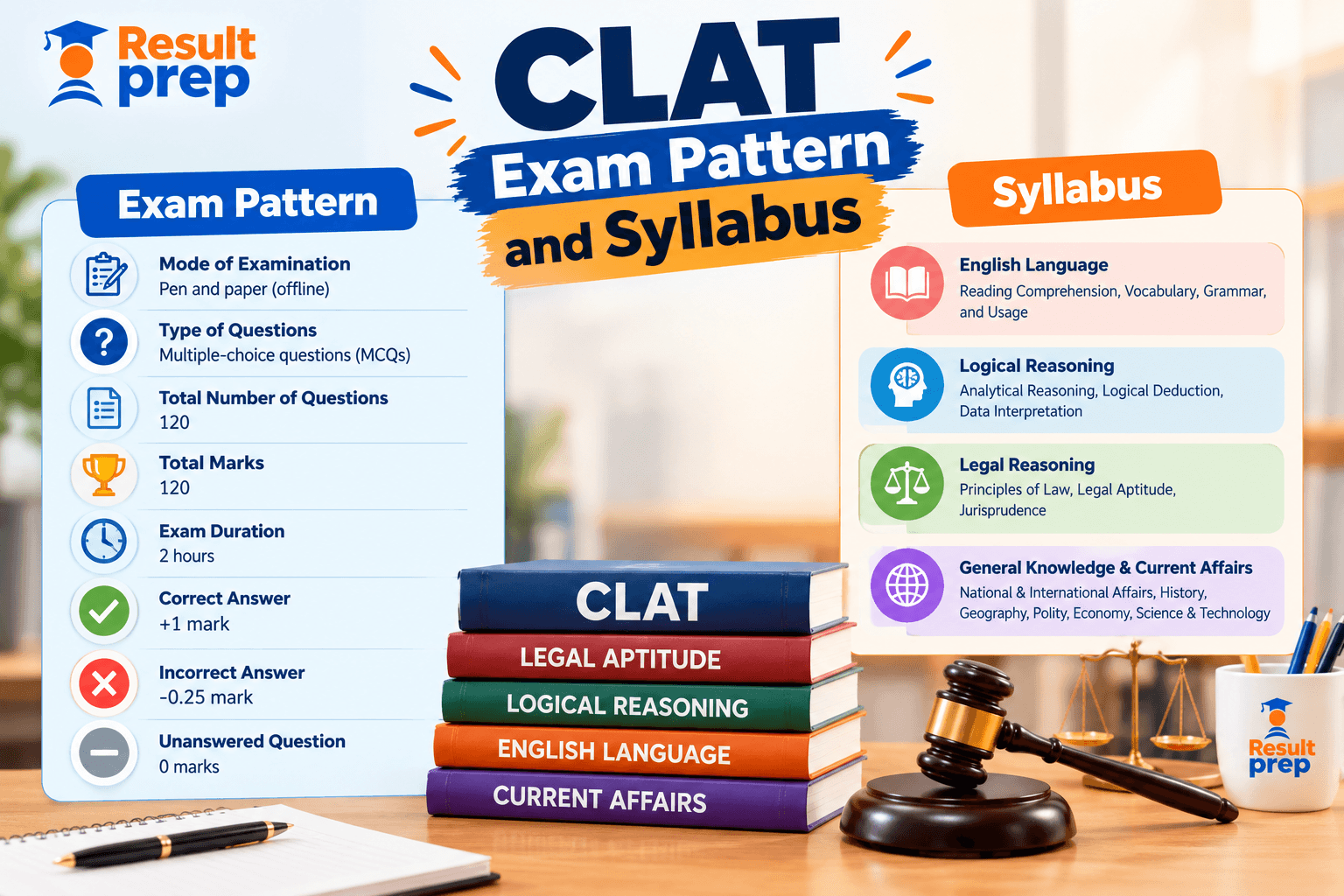
Everything Students Should Know About the CLAT Exam Pattern and Syllabus
The complete guide to the CLAT 2027 exam pattern and syllabus: 120-question passage format, 5 sectional syllabi, marking scheme, offline OMR logistics, and preparation roadmaps.

CLAT - Criteria for Eligibility: Age Range, Criteria, and Prerequisites
A complete guide to CLAT 2027 eligibility: Minimum marks in Class 12, no age limit rules, stream flexibility, reservation categories, and CLAT UG vs. PG comparison.

How to Apply for CLAT: A Step-By-Step Guide For Law Aspirants
A complete walkthrough of the CLAT application process: Step-by-step registration on the Consortium portal, document specifications, fee payment, common pitfalls, and post-submission steps.