Logical Reasoning for Beginners: Cracking CLAT & IPMAT Logic Sections
An introductory guide to critical reasoning, syllogisms, statements, assumptions, and logical deductions for entrance exams.
Introduction: Demystifying Logical Reasoning for Beginners: Cracking CLAT & IPMAT Logic Sections
Welcome to our authoritative, expert-guided handbook on Logical Reasoning for Beginners: Cracking CLAT & IPMAT Logic Sections. In the highly competitive ecosystem of entrance examinations, staying ahead is no longer just an advantage—it is a mandatory condition. As admissions percentiles creep higher every year, students attempting the major entrances require a rigorous, analytical, and structured path to secure their seats. This guide breaks down the core methodologies and practical strategies you need to apply to achieve success.
When approaching Logical Reasoning for Beginners, it is vital to recognize that competitive entrances do not merely test what you know; they test your psychological endurance, reading speed, and contextual reasoning. Whether you are balancing school workloads or spending a gap year preparing, success hinges on structured active learning, systematic practice, and data-driven mock corrections. Let's delve into the core parameters that define success on this topic.
The Core Pillars of Law Entrance Preparation
Modern law entrance examinations, most notably CLAT, have pivoted entirely away from testing rote legal knowledge. Instead, they represent 120 minutes of intense reading comprehension. The examiner's goal is to evaluate your ability to identify core arguments, draw logical deductions under immense pressure, and apply legal principles consistently. To master this, you must build high-speed reading habits. Reading standard editorials from *The Hindu* or *The Indian Express* for at least 45 minutes daily is non-negotiable.
Furthermore, you must develop a structural understanding of core law branches: Torts, Contracts, Crimes, and Constitutional law. Do not study these to pass a law school examination; study them to understand the logical rules that govern them. This is the bedrock of the legal reasoning segment. Your main target is to isolate the legal principles written in the passage, ignore any outside knowledge you have, and apply that principle strictly to the fact scenario provided.
Advanced Reasoning and GK Compilation
Beyond legal aptitude, the General Knowledge and Logical Reasoning segments act as critical rank-defiers. For General Knowledge, passive reading is highly ineffective. You must implement a structured note-making system. Group your notes into dynamic topics such as International Relations, Landmark Judgments, National Policies, and Science & Tech. Combine this with daily quiz rounds and active recall sessions. ResultPrep recommend keeping weekly revision windows to solidify your memory retention.
For logical reasoning, focus on critical reasoning basics: statement assumptions, course of action, strengthening and weakening arguments, and logical flaws. Learn how to map argument structures mentally. Recognize the premise, the intermediate steps, and the final conclusion. When you can spot these elements in under 45 seconds, your accuracy will climb significantly.
Actionable Expert Insights for Aspirants
Success in this competitive area requires practical, actionable habits that build daily momentum. First, keep a strict record of your study hours and mock scores to track your trajectory. Second, solve at least 15-20 practice questions daily on your weak areas to build conceptual confidence. Third, discuss complex questions with peers and mentors; explaining a topic to someone else is the fastest way to master it yourself. Finally, stay committed to your daily schedule; consistency beats talent every single time.
Common Student Mistakes and solutions
Common Student Mistakes & NLU Alumni Solutions
- Factual Overrides: Students often apply their own moral compass or real-world legal knowledge instead of the passage principle. Solution: Treat the principle written in the exam as absolute truth, even if it contradicts normal laws.
- GK Hoarding: Spending 4 hours daily downloading monthly GK PDFs from multiple sources. Solution: Stick to one daily newspaper, one premium monthly compilation from ResultPrep, and focus on active revision.
- Ignoring Math: Neglecting the Data Interpretation math section thinking it is only 10% of the paper. Solution: Math is a high-scoring section where 10 marks can jump your NLU allotment by 500 ranks. Practice 5 DI sets weekly.
Surgical Preparation Strategy
Month-by-Month Law Exam Preparation Strategy
Your preparation strategy should be divided into three distinct phases:
- Phase 1 (Concepts & Reading): Devote the initial months to finishing legal theory basics, reading daily editorials, and building speed.
- Phase 2 (Sectional Testing): Start writing sectional mock tests. Analyze your accuracy per topic and identify logic flaws.
- Phase 3 (Full-Length Mocks & Strategy): Write 2 full-length mocks weekly. Analyze timing per section, optimize your paper-attempting order, and double-down on revision.
Authoritative Legal Resources
- Official syllabus and notification updates: Consortium of NLUs Official Portal
- Government education portals: Ministry of Education, India
Discussion (5)
Sneha Reddy
The distinction between Statement-Assumption and Course-of-Action completely changed how I attempt critical reasoning.
Shruti Desai
I used to rely on my 'gut feeling' for logical flaws. Learning the formal fallacies (Ad Hominem, Strawman) makes it so mathematical.
Manish Das
The 'Premise-Conclusion' mapping technique is taking me 2 minutes per question right now. Will this speed up with practice?
Nikhil Joshi
This is the best introductory guide I've seen. Skipping the heavy jargon and focusing on practical application is exactly what I needed.
Rohan Chatterjee
Are syllogisms (Some A are B) still heavily tested, or is it mostly paragraph-based reasoning now?
Related Articles in CLAT Preparation
Everything Students Should Know About the CLAT Exam Pattern and Syllabus
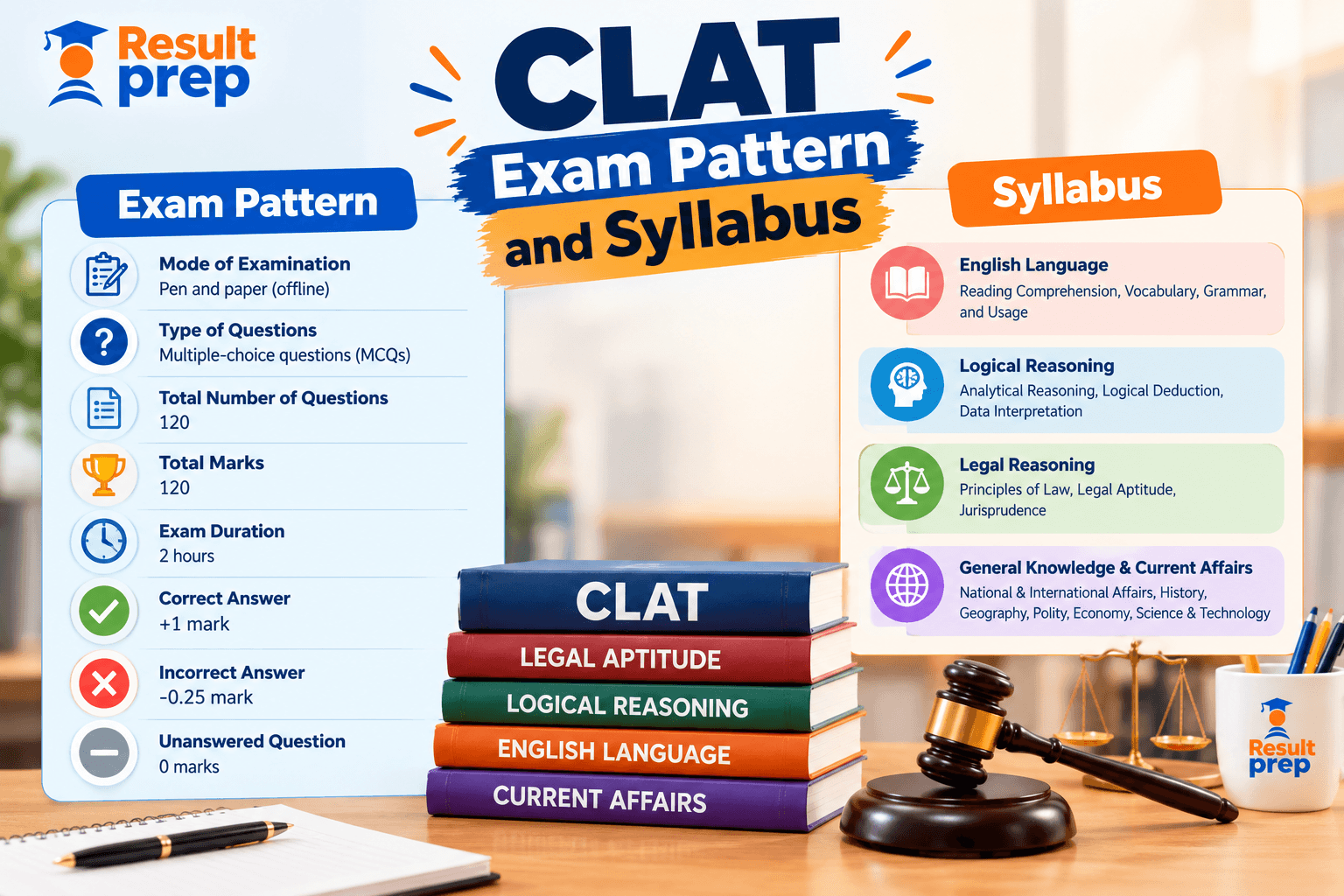
The complete guide to the CLAT 2027 exam pattern and syllabus: 120-question passage format, 5 sectional syllabi, marking scheme, offline OMR logistics, and preparation roadmaps.

CLAT - Criteria for Eligibility: Age Range, Criteria, and Prerequisites
A complete guide to CLAT 2027 eligibility: Minimum marks in Class 12, no age limit rules, stream flexibility, reservation categories, and CLAT UG vs. PG comparison.

How to Apply for CLAT: A Step-By-Step Guide For Law Aspirants
A complete walkthrough of the CLAT application process: Step-by-step registration on the Consortium portal, document specifications, fee payment, common pitfalls, and post-submission steps.