The 30-Day CLAT Checklist: Ultimate Revision and Testing Strategy
The final stretch roadmap containing revision checkpoints, mock frequency, and physical/mental habits for the final 30 days before CLAT.
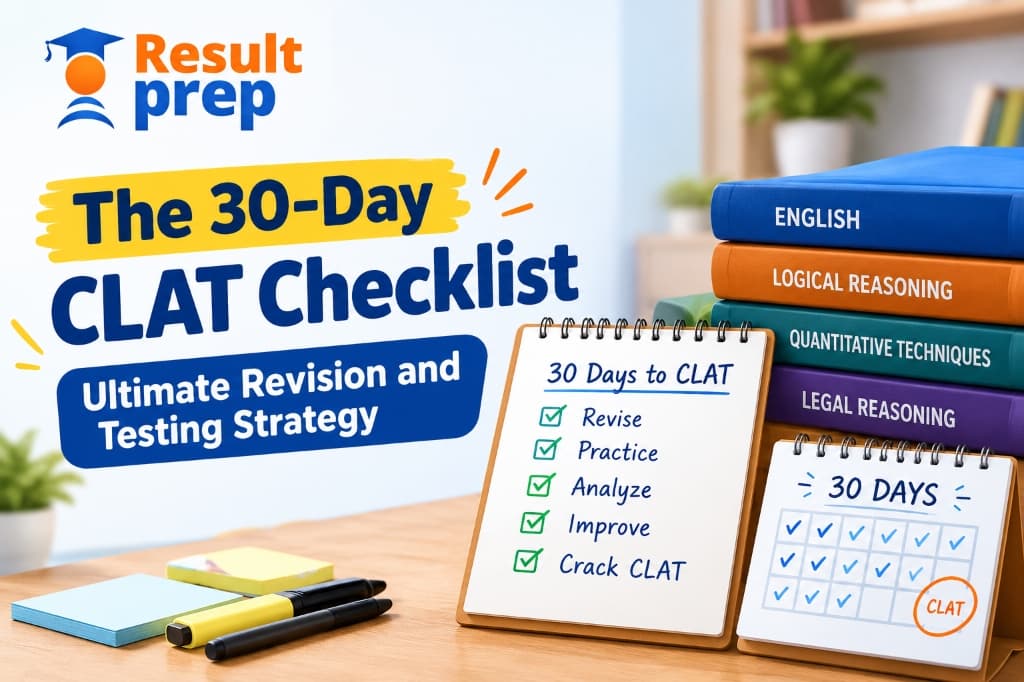
The final thirty days leading up to the Common Law Admission Test (CLAT) represent the most critical, highly volatile, and psychologically demanding phase of a law aspirant's entire preparation journey. After an exhausting twelve to twenty-four months of intense academic preparation—involving the memorization of thousands of current affairs events, the rigorous study of complex legal maxims, and the relentless practice of abstract logical reasoning—the final stretch is where champions are ultimately separated from the rest of the pack. However, a profound misconception exists among the student community regarding how to utilize this time. The vast majority of aspirants treat the final thirty days as an opportunity to violently cram new, previously untouched syllabus topics. They panic-buy new textbooks, download hundreds of fresh PDF compendiums, and attempt to learn entirely new mathematical concepts. This approach is not merely ineffective; it is strategically suicidal. The final month must not be treated as a period of academic acquisition. Instead, it must be treated as a period of rigorous consolidation, psychological hardening, and extreme precision tuning. This comprehensive, 1500-word masterclass provides an elite, day-by-day architectural blueprint—designed by top-tier NLU alumni—detailing exactly how to structure your final 30 days. It covers the academic lockdown, the simulation protocol, circadian rhythm alignment, and the critical cognitive tapering required to ensure you peak at the exact moment you sit inside the examination hall.
Phase 1: The Tactical Academic Lockdown (Days 30 to 15)
The first fifteen days of this final month require a massive psychological shift. You must transition from a mindset of "expansion" to a mindset of "consolidation." Your primary objective during this phase is to aggressively plug the leaking holes in your existing knowledge base rather than attempting to build entirely new academic structures.
The Strict Syllabus Freeze
On Day 30, you must initiate a strict, non-negotiable syllabus freeze. You must formally accept the reality that whatever new concepts you have not learned by this point will not be learned before the exam. If you have completely ignored modern history or a specific subset of algebraic geometry for the last year, attempting to learn it now will only induce severe panic and destroy your confidence. Instead, you must aggressively double down on your established strengths. If your accuracy in Legal Aptitude is currently sitting at 75%, your goal for these fifteen days is to refine your technique until that accuracy hits a bulletproof 90%. Review your entire Error Log from the past six months. Re-read every single incorrect answer you made in previous mock tests and ensure the logical pathways to the correct answers are permanently hardwired into your brain.
The Sectional Target Matrix
During Phase 1, you must deconstruct the exam into micro-targets. Do not look at the daunting overall score requirement of 95+. Instead, build a Sectional Target Matrix. Determine exactly how many marks you need to extract from each specific section to hit your aggregate goal. For example: target 22/30 in Legal, 20/30 in GK, 18/24 in Logical, 20/24 in English, and 8/12 in Math. Once you have established these micro-targets, structure your daily study sessions to strictly mirror them. Spend your morning hours ruthlessly practicing the sections where you are currently falling short of your micro-target, utilizing intensive, timed sectional quizzes to force your speed upward.
Phase 2: The Simulation Protocol (Days 15 to 5)
As you enter the final two weeks of preparation, your focus must shift violently from academic study to environmental and psychological simulation. The CLAT is not administered in the quiet, perfectly air-conditioned comfort of your bedroom. It is administered in highly stressful, often noisy public school environments, surrounded by hundreds of panicked competitors. You must condition your central nervous system to perform flawlessly under these exact hostile conditions.
Circadian Rhythm Alignment
One of the most devastating, yet easily preventable, mistakes students make is ignoring their biological clock. If you have spent the last year studying until 3:00 AM and waking up at 11:00 AM, your brain is biologically programmed to be sluggish and groggy at 2:00 PM—which happens to be the exact time the CLAT is conducted. Beginning on Day 15, you must violently reset your circadian rhythm. You must wake up at 7:00 AM every single day. More importantly, you must ensure that your absolute peak cognitive alertness occurs precisely between 2:00 PM and 4:00 PM.
The 2:00 PM Mock Test Strategy
To enforce this circadian alignment, all remaining mock tests must be taken strictly between 2:00 PM and 4:00 PM. Furthermore, you must simulate the physical exam environment with absolute ruthlessness. Do not take the mock test lying on your bed. Sit at a hard wooden desk. Wear a restrictive face mask if the exam guidelines require it. Do not keep a water bottle on the table if it is not allowed in the actual center. Do not pause the timer to go to the bathroom. You must train your body to withstand 120 minutes of severe physical and mental discomfort without your cognitive performance dropping. Take a full-length mock test every alternate day during this phase (Days 15, 13, 11, 9, 7, and 5) and spend the non-testing days executing the 3-Step Mock Analysis Framework.
Phase 3: The Decompression Strategy (The Final 5 Days)
The final five days are where the vast majority of students self-destruct. Driven by sheer terror, they attempt to study for fourteen hours a day, furiously flipping through GK compendiums and taking multiple mock tests per day. This guarantees that they will walk into the examination hall in a state of severe cognitive burnout, suffering from brain fog and extreme decision fatigue.
Strict Cognitive Tapering
Just as Olympic athletes taper their physical training in the days leading up to a gold-medal race to allow their muscles to fully recover, you must aggressively taper your cognitive load. On Day 5, you must take your absolute final mock test. Under absolutely no circumstances should you take a mock test in the final four days. If you score poorly on a mock test two days before the real exam, your self-confidence will be entirely shattered, and you will carry that anxiety straight into the testing center.
During these final days, your academic study must be restricted to a maximum of three to four hours of light, passive revision. Slowly review your highly summarized GK notes, gently glance over your math formulas, and casually read a few editorials just to keep your reading speed warm. Your primary objective is to allow your brain to rest, recover, and consolidate the massive amounts of data you have fed it over the past year.
The Night Before the Exam
The night before the CLAT is not a time for heroic, last-minute revisions. By 6:00 PM, you must entirely close all your textbooks, pack away your notes, and physically remove them from your sight. Organize your logistics meticulously: print out multiple copies of your admit card, prepare a transparent pencil pouch with extra black ballpoint pens, locate your government ID, and map out the exact route to your exam center, factoring in heavy traffic. Eat a light, highly digestible dinner, and be in bed by 10:00 PM. You may struggle to sleep due to adrenaline, but merely resting in a dark room allows your nervous system to reset.
Non-Academic Checklists: Diet, Sleep, and Psychology
Finally, your physical health during these 30 days must be treated with the exact same rigor as your academic health. A single bout of food poisoning or a severe viral infection in the final week can completely destroy a year of preparation. You must enforce a strict, conservative diet. Eliminate all outside food, heavy processed meals, and excessive caffeine. Hydrate aggressively, aiming for three liters of water daily.
Psychologically, you must fiercely protect your mental space. Disconnect entirely from toxic WhatsApp or Telegram study groups where panicked students constantly post obscure, highly difficult questions designed solely to prove their own intelligence. These groups breed unnecessary anxiety and impostor syndrome. Isolate yourself, trust the intense preparation you have executed, and focus entirely on your own metrics.
The final 30 days are a test of character, discipline, and strategic restraint. By executing the strict syllabus freeze, aggressively aligning your circadian rhythm, simulating the harsh exam environment, and implementing a protective cognitive taper in the final week, you ensure that you walk into the CLAT examination hall not as an exhausted, panicked student, but as a sharply honed, well-rested weapon ready to secure a top rank.
Discussion (7)
Priya Sharma
Stopping all new syllabus coverage 30 days before the exam is scary but it makes total sense.
Amit Patel
The cognitive taper in the last week is so crucial. My seniors burned out two days before D-Day.
Manish Das
I am printing this checklist and sticking it on my wall. The environmental simulation (no AC, hard chair) is a great tip.
Arjun Nair
The emphasis on a strict sleep schedule is underrated. Sleep deprivation destroys reading speed.
Arjun Desai
Should I still read the newspaper in the last week, or just rely on compendiums?
Karan Singh
Is it advisable to give a mock test the day before the actual CLAT exam?
Rohan Das
The 'Ego Management' reminder is what I needed. I won't get stuck on a difficult logic puzzle.
Related Articles in CLAT Preparation
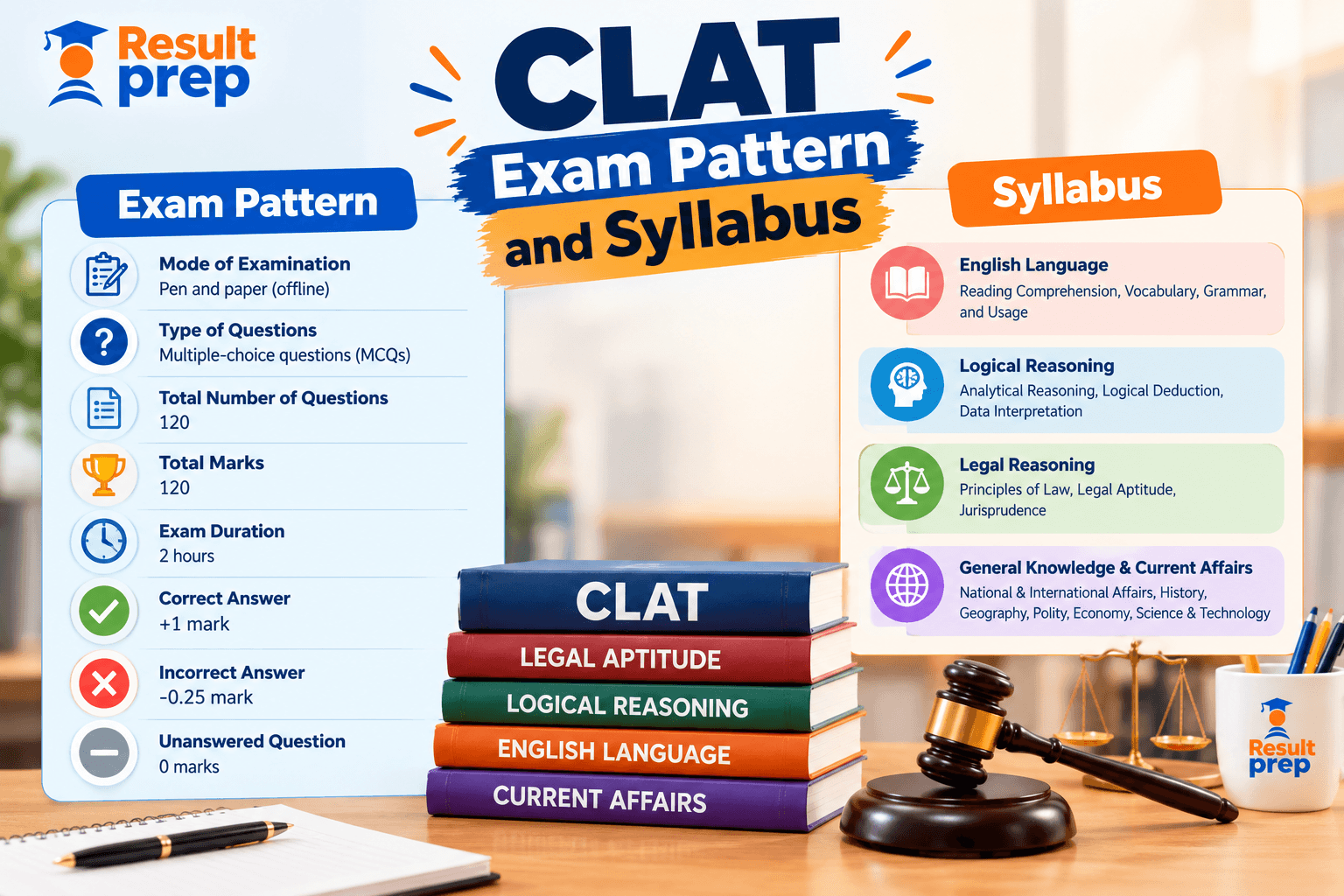
Everything Students Should Know About the CLAT Exam Pattern and Syllabus
The complete guide to the CLAT 2027 exam pattern and syllabus: 120-question passage format, 5 sectional syllabi, marking scheme, offline OMR logistics, and preparation roadmaps.
CLAT - Criteria for Eligibility: Age Range, Criteria, and Prerequisites
A complete guide to CLAT 2027 eligibility: Minimum marks in Class 12, no age limit rules, stream flexibility, reservation categories, and CLAT UG vs. PG comparison.

How to Apply for CLAT: A Step-By-Step Guide For Law Aspirants
A complete walkthrough of the CLAT application process: Step-by-step registration on the Consortium portal, document specifications, fee payment, common pitfalls, and post-submission steps.