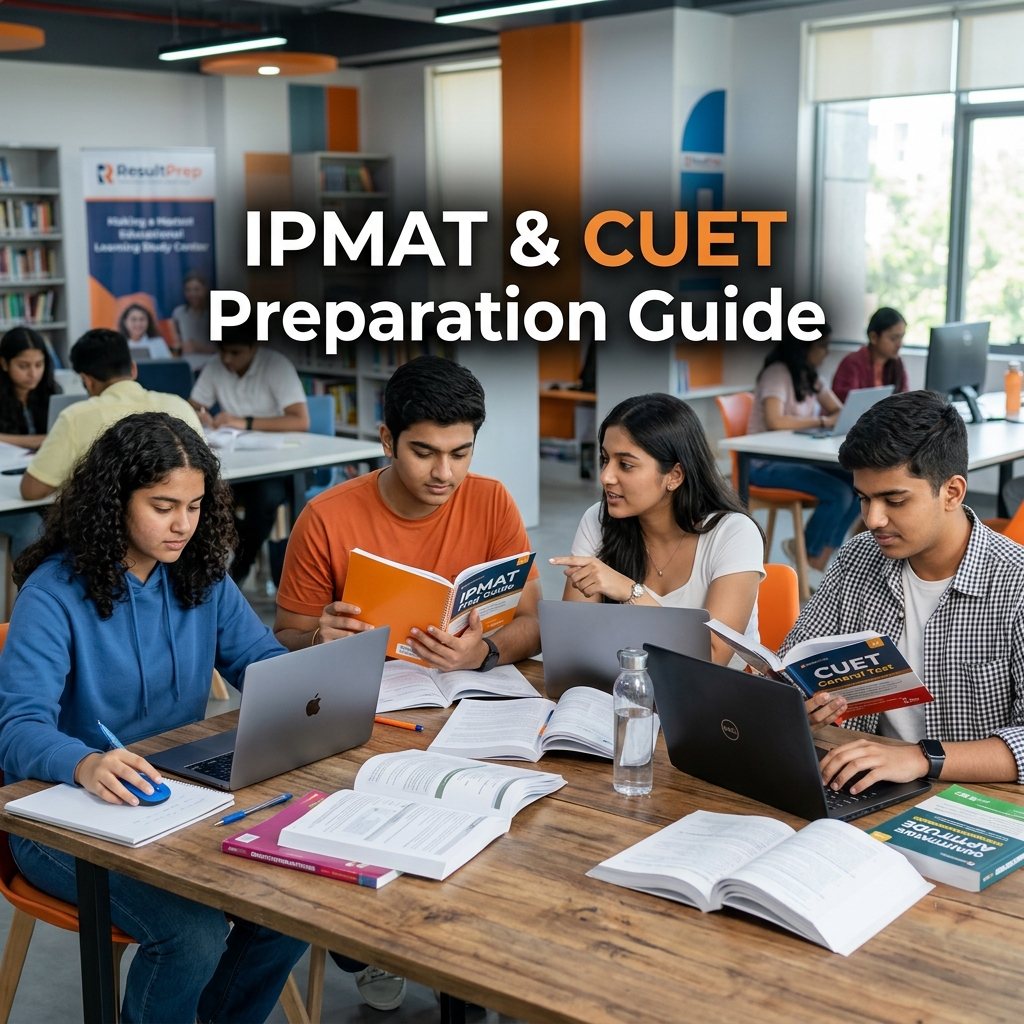
If you are currently in Class 11 or 12, chances are you’re already thinking about your future. Most students follow the traditional path—prepare for board exams, then decide what to do next. But what if you could plan smarter and secure admission into top institutions right after Class 12?
That’s where exams like IPMAT and CUET come into the picture. These exams are not just alternatives—they are powerful opportunities. They open doors to top IIMs, central universities, and some of the most prestigious undergraduate programs in India. And the best part? You can start preparing early while you’re still in school.
In this guide, we’ll break down everything you need to know about IPMAT and CUET, why they matter, and how you can start preparing effectively.
What is IPMAT?
IPMAT (Integrated Program in Management Aptitude Test) is an entrance exam conducted by top IIMs like IIM Indore and IIM Rohtak for their 5-year Integrated Program in Management (IPM).
Key Highlights
- Designed for students after Class 12
- Offers direct entry into IIMs
- Combines undergraduate + postgraduate (MBA) degree
- Focuses on aptitude, reasoning, and communication skills
Exam Structure
Quantitative Ability
Includes both Multiple Choice Questions (MCQ) and Short Answer (SA) types.
Verbal Ability
English comprehension, grammar, and vocabulary evaluation.
What is CUET?
CUET (Common University Entrance Test) is a national-level exam conducted for admission into central universities like Delhi University, BHU, JNU, and many others.
Key Highlights
- Accepted by 200+ universities across India
- Covers a wide range of courses (BA, BCom, BSc, etc.)
- Based on Class 12 syllabus + aptitude sections
Exam Structure
Language Test
Choice between English/Hindi and other regional languages.
Domain Subjects
Based specifically on your stream (Commerce, Science, Humanities).
General Test
Logical reasoning, GK, and basic quantitative aptitude.
Why Consider IPMAT & CUET?
1. Early Entry into Top Institutions
IPMAT allows you to enter IIMs right after Class 12, while CUET gives access to top central universities through a single exam.
2. Better Career Clarity
- • Understand your strengths early
- • Explore diverse career options
- • Build professional confidence
3. Reduced Pressure Later
Secure your path early and avoid the uncertainty that comes after graduation. Focus on skill-building from day one.
4. Holistic Skill Development
Master logical thinking, problem-solving, and communication skills that are vital for any future career.
When Should You Start Preparing?
If You’re in Class 11
- • Focus on building strong basics
- • Develop a daily reading habit
- • Start with light aptitude practice
If You’re in Class 12
- • Begin structured, goal-oriented prep
- • Take regular full-length mocks
- • Improve speed and accuracy
How to Prepare
Strengthen Basics
Focus on math, English, and reasoning fundamentals.
Daily Study Routine
Balance Quant, English, and Reasoning (30 mins each).
Practice Regularly
Solve past questions and attempt sectional tests.
Read Daily
Read newspapers (The Hindu/Express) and articles.
Take Mock Tests
Start slow and increase frequency as you progress.
Time Management
Learn smart question selection and accuracy hacks.
Common Mistakes to Avoid
IPMAT vs CUET: The Choice
Choose IPMAT if:
"You aim for IIMs and are strictly interested in Management."
Choose CUET if:
"You want course flexibility and target top Central Universities."
"Best Approach? Prepare for both to keep all options open!"
FAQs
Can I prepare for both exams together?
Yes, there is strong overlap in the aptitude and language sections.
Is coaching necessary?
Not mandatory, but extremely helpful for structured guidance and mentorship.
How difficult are these exams?
Competitive but manageable with consistent practice and strategy.
Do board marks matter for CUET?
CUET score is the primary criterion, but passing boards is a mandatory requirement.
The competition today is not just about working hard—it’s about working smart. Stay consistent, focus on learning, and keep improving.