IPMAT Verbal Ability Guide: Vocabulary, Grammar, and Reading Comprehension
A comprehensive workbook to dominate the English and Verbal sections of IIM Indore and Rohtak IPMAT exams.
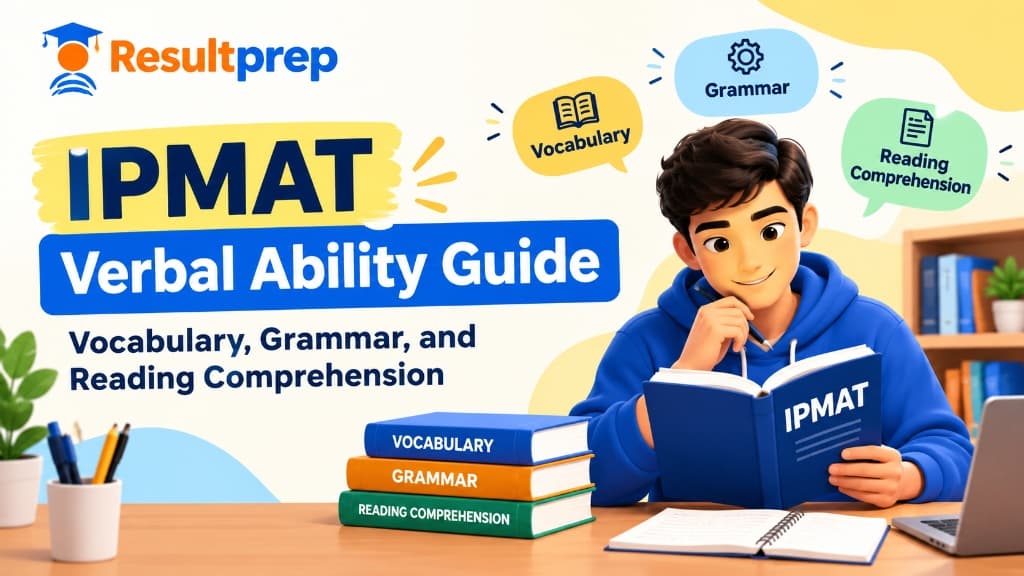
Securing a seat in the Integrated Programme in Management (IPM) at prestigious institutions like IIM Indore and IIM Rohtak requires an uncompromising command over the English language. However, the IPMAT Verbal Ability section is fundamentally misunderstood by the vast majority of aspirants. It is not merely a high school English test designed to check your spelling or rote grammar rules. Instead, it is a rigorous screening mechanism designed to evaluate your capacity for elite corporate communication, high-speed logical deduction, and complex syntactical reasoning. The Verbal Ability section often acts as the decisive filter—while many students can master the quantitative aptitude section through sheer practice, the verbal section requires a nuanced, long-term cognitive shift. This comprehensive guide provides a highly structured, data-driven framework to help you dominate the three core pillars of IPMAT Verbal: Vocabulary, Grammar, and Reading Comprehension, elevating your percentile beyond the 99th threshold.
The Lexical Foundation: Mastering Contextual Vocabulary
The vocabulary questions in IPMAT—typically appearing as synonyms, antonyms, and complex fill-in-the-blanks—are designed to trap students who rely on rote memorization. Memorizing 3,000 words from a standard dictionary is an incredibly inefficient strategy. The IIMs test your ability to deduce a word's meaning based on its surrounding context, not just your memory retrieval speed.
The Power of Etymology and Root Words
Instead of memorizing entire words, you must study the building blocks of the English language: root words, prefixes, and suffixes. For example, knowing that the Latin root 'loqu' means 'to speak' instantly gives you the power to decipher words like loquacious (talkative), eloquent (speaking beautifully), soliloquy (speaking alone), and somniloquy (sleep talking). By mastering 200 high-frequency Greek and Latin roots, you effectively unlock the meanings of over 2,000 complex vocabulary words. This creates a scalable, logical system for vocabulary acquisition rather than relying on brute force.
Tone Recognition in Fill-in-the-Blanks
When approaching fill-in-the-blank questions (especially double or triple blanks), do not immediately look at the options. First, read the sentence and identify the "directional tone." Is the sentence shifting from a positive premise to a negative conclusion? Look for hinge words like however, despite, although, or nevertheless. If the sentence says, "Despite his _____ demeanor, he was actually quite ruthless in board meetings," the word "Despite" indicates a contrast. Therefore, the blank must contain a word that means the opposite of ruthless (e.g., benign, affable). Deduce the tone first, pre-guess the word, and only then look at the options to find the closest match.
The Grammatical Matrix: Syntactical Logic
The grammar segment of IPMAT separates the amateurs from the elite. Most students rely on their "ear"—if a sentence sounds correct, they assume it is correct. This is a fatal flaw. Spoken English is rife with grammatical errors that sound perfectly natural. The IPMAT tests strict, formal written English syntax through Error Spotting and Sentence Correction questions.
"IPMAT grammar is not about what 'sounds correct' to the ear; it is about absolute, mathematical adherence to structural English syntax. You must apply rules, not intuition."
Parallelism and Modifiers
Two of the most frequently tested concepts are Parallel Structure and Misplaced Modifiers. Parallelism dictates that items in a list or comparison must be in the exact same grammatical form. For instance, "He likes hiking, swimming, and to run" is incorrect; it must be "hiking, swimming, and running." While this seems simple, the exam setters will bury this error within a dense, 40-word sentence about global economics. You must train your eyes to scan for conjunctions (and, but, or) and immediately check the grammatical weight of the elements on either side.
Misplaced modifiers occur when a descriptive phrase is placed too far from the noun it is describing, leading to illogical or comical meanings. For example, "Covered in mustard, I ate the hotdog." This implies you were covered in mustard, not the hotdog. In IPMAT sentence correction, look specifically for introductory participial phrases ending in a comma; the noun immediately following the comma MUST be the entity performing the action described in the phrase.
Conquering Reading Comprehension (RC)
The Reading Comprehension section evaluates your ability to process dense, abstract information under extreme time pressure. Passages in the IPMAT are often sourced from high-level publications like The Economist, The New York Times, or academic journals, covering sociology, philosophy, evolutionary biology, and macroeconomics. You are not reading to enjoy the narrative; you are reading to extract logical architecture.
Identifying the Primary Purpose and Tone
Every RC passage has a structural skeleton. Your primary goal during the initial reading is not to memorize the facts or dates mentioned, but to map this skeleton. What is the author's primary purpose? Are they arguing a point, evaluating two competing theories, or merely describing a historical phenomenon? Pay strict attention to the tone of the author. Is it objective, cynical, cautiously optimistic, or condescending? The majority of inference-based questions can be solved simply by eliminating options that do not match the author's overall tone.
Active Engagement and Paragraph Mapping
Passive reading is the enemy of comprehension. You must engage actively with the text. After reading each paragraph, pause for exactly two seconds and mentally summarize its core point in three to four words. By the time you reach the end of the passage, you should have a mental map of the logical flow. When a specific detail-oriented question is asked, your mental map will instantly direct you to the correct paragraph to scan for the answer, rather than forcing you to re-read the entire passage.
The Ultimate Challenge: Paragraph Jumbles (Para-jumbles)
Para-jumbles—particularly the non-MCQ variety featured in IIM Indore's IPMAT—are widely considered the most difficult questions in the Verbal section. You are given four or five jumbled sentences and must arrange them into a coherent paragraph without the aid of multiple-choice options. This requires absolute precision.
Tracking Pronouns and Transition Words
Solving Para-jumbles is like assembling a puzzle; you must look for interlocking pieces. The most reliable pieces are Pronouns (he, she, it, they, this, these). A sentence starting with "These revolutionary policies..." cannot be the opening sentence; it must immediately follow the sentence that explicitly defines what those policies are. Similarly, transition words (However, Therefore, Consequently, Furthermore) dictate the logical sequence. A "Therefore" sentence is almost always a concluding thought or a deduction based on the immediately preceding premise. By identifying these mandatory pairs (two sentences that absolutely must go together), you drastically reduce the complexity of the jumble.
A Structured 3-Month Verbal Blueprint
To master the IPMAT Verbal section, you must adopt a systematic, daily routine. Follow this structured 3-month implementation strategy:
Month 1: The Core Foundation
Dedicate your first month to mastering the absolute basics of grammar. Study the rules of Subject-Verb Agreement, Parallelism, Modifiers, and Tenses. Do not solve RC passages yet. Instead, spend 45 minutes every day reading editorials from The Hindu. Focus entirely on building your reading stamina and identifying the author's tone. Begin studying 10 new Greek/Latin root words daily.
Month 2: Structural Application
Transition to solving specific question types. Practice 30 Error Spotting and Sentence Correction questions daily, forcing yourself to write down the exact grammatical rule being tested for every question. Begin solving 2 to 3 RC passages daily, specifically focusing on abstract or philosophical topics. Introduce Para-jumble practice, focusing entirely on identifying mandatory pairs rather than solving the whole sequence.
Month 3: Speed, Integration, and Mock Testing
The final month is all about execution under pressure. Begin taking full-length 40-minute Verbal sectional mock tests. Analyze every single mock meticulously. If you get a vocabulary question wrong, add that word to your digital log. If you get an RC question wrong, analyze whether it was a reading failure or a logic failure. Your goal is to reach a reading speed of 350+ words per minute while maintaining an 85% accuracy rate.
Mastering the Verbal Ability section of the IPMAT is a transformative intellectual journey. By discarding rote learning in favor of root words, abandoning intuition for strict syntactical rules, and treating Reading Comprehension as an exercise in structural logic, you will develop the elite communication skills required to excel not only in the entrance exam but in the boardrooms of the future.
Discussion (7)
Rohan Das
The advice on treating Grammar like a mathematical framework rather than 'gut feeling' is brilliant. I was losing so many marks.
Rohan Chatterjee
Contextual Deduction for vocabulary is the only way to survive. I spent 2 months memorizing Word Power Made Easy and still got confused.
Sneha Reddy
Are Para-jumbles tested heavily in JIPMAT as well, or just Indore?
Kavya Menon
I've completely abandoned dictionary lists and moved to the Sentence-Mining protocol.
Rahul Verma
IIM Indore passages are notoriously dense. Alternating between The Economist and LiveMint has definitely built my reading stamina.
Ravi Teja
The 40-minute Verbal Pivot is a lifesaver. Dropping a 4-question RC passage to secure 10 easy grammar questions is the ultimate hack.
Anjali Verma
The 'Author-First' mindset is something I struggle with. I always accidentally project my own views into the inference questions.
Related Articles in IPMAT Preparation
What to Consider Before Enrolling in an IPMAT Coaching Center
A comprehensive 12-point checklist for aspirants and parents: Evaluate faculty pedigree, batch sizes, mock analytics, fee transparency, commute logistics, and WAT-PI interview coaching.

How to Pick Bangalore's Best IPMAT Coaching Center
A comprehensive 10-point evaluation guide for students and parents: Assess faculty depth, study material rigor, batch sizes, mock analytics, commute logistics, and ResultPrep programs in Bangalore.
How to Select the Best IPMAT Coaching Classes in Bangalore
A practical decision framework for Bangalore IPMAT aspirants: Evaluating faculty expertise, batch sizes, mock test analytics, personalized mentorship, and why ResultPrep Vidyaranyapura stands out.