Quantitative Aptitude Shortcuts for IPMAT: Save 30% Time in Calculations
Learn advanced calculation shortcuts, Vedic math techniques, and logical reasoning options elimination methods for IPMAT Quant.
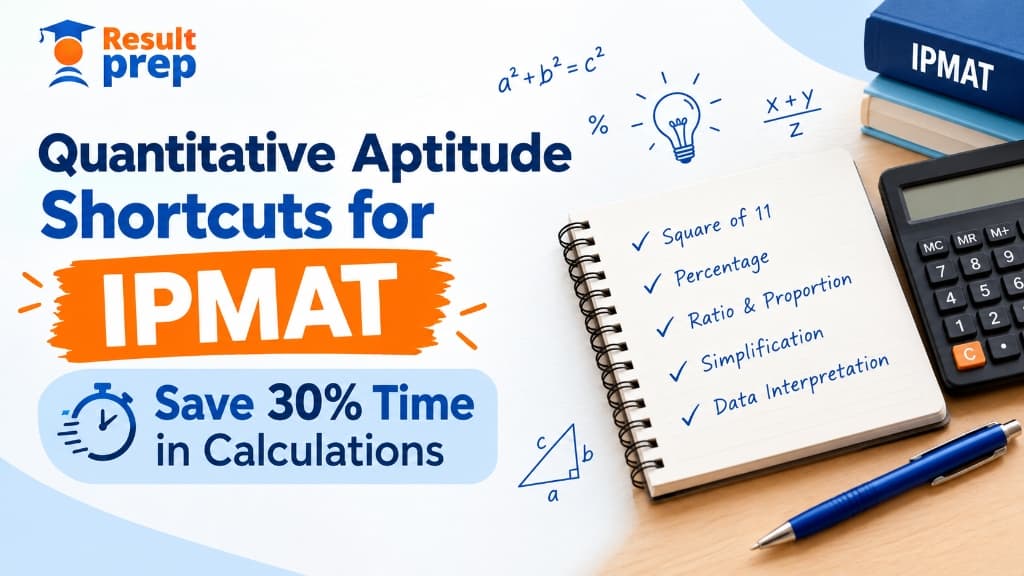
Welcome to the definitive manual for cracking the Quantitative Aptitude section of IPMAT. If your objective is securing a seat at the prestigious IIM Indore for the 5-Year Integrated Programme in Management, you must approach this examination with surgical precision. Unlike traditional high-school mathematics exams, the IPMAT Quantitative section is a grueling high-speed evaluation that screens for elite calculation speed and advanced logical estimation. This guide dismantles the exam's mathematical complexities and provides a rigorous, data-driven framework to elevate your calculation speed by over 30%.
Decoding the IPMAT Quant: The Speed Evaluation Architecture
The IPMAT represents a paradigm shift in Indian undergraduate entrances. Because IIM Indore holds the undisputed title of India's premier management school for high school graduates, the testing metrics are ruthlessly competitive. The exam is split into two distinct, interconnected components for the math section: Multiple Choice Questions (MCQ) and Short Answer (SA).
The MCQ Objective Gatekeeper
The MCQ section acts as the initial speed filter. It is an intensive objective section testing critical arithmetic, high-level algebra, and data interpretation. Crucially, your entire selection will only be secured if you successfully clear the extremely tight sectional cutoffs. Aspirants often make the fatal error of solving these questions using long-form school methods, only to fail the initial time limit. You are essentially competing against a clock that allows less than 90 seconds per complex problem.
The Short Answer (SA) Subjective Gauntlet
This is where the exam is truly won or lost. The SA section demands structured, mental calculations without the safety net of multiple-choice options. You are not expected to guess; you are tested on how logically you can construct equations, apply Vedic math rules to complex numbers, and derive exact answers under extreme time pressure. A single calculation error here cascades into a complete loss of marks.
Strategic IPMAT Preparation Methodologies
Clearing the IPMAT requires abandoning generic school math habits. You must transition into a highly disciplined, outcome-oriented preparation protocol that balances raw calculation speed with conceptual depth.
"The IPMAT does not merely test your knowledge of mathematics; it tests your capacity for high-speed, structural estimation. Mastering Vedic calculation frameworks is non-negotiable."
Mastering the Digit-Sum Framework
To dominate the objective section, you must adopt the Digit-Sum (Digital Root) method. This framework forces your calculations into a highly readable, single-digit structure that examiners actively exploit for trap options. First, clearly state the core equation. Next, find the digital root of the operands. Then, demonstrate rigorous application by cross-checking the digital root of the multiple-choice options. Finally, deliver a definitive, unambiguous selection. This allows you to bypass massive multiplications entirely.
Structuring High-Scoring Vedic Math Habits
The SA section evaluates your raw processing power on arithmetic and algebraic equations. Slow, step-by-step written calculations will be heavily penalized by the clock. Your mental math must feature sharp base multiplications, instantaneous percentage-fraction conversions, and a balanced, pragmatic approximation. Practice writing out squares up to 30 weekly, focusing on integrating Vedic base methods to lend incredible speed to your answers. When you memorize fraction equivalencies up to 1/20, complex Data Interpretation sets become simple mental exercises.
The Critical Role of Timed Sectional Simulations
Given the rigorous demands of solving 45 questions in 40 minutes, time management is your greatest adversary. Taking official, full-length IPMAT mock tests is mandatory. You must condition yourself to budget exactly 60 seconds per easy problem and 90 seconds for complex DI sets. For aspirants struggling to coordinate these dual requirements, enrolling in dedicated IPMAT coaching can provide the intensive shortcuts and expert feedback necessary to refine your speed. Deep analysis of these mocks is required to patch your specific calculation flaws.
Ultimately, cracking the IPMAT requires immense discipline, psychological resilience, and a willingness to embrace extreme academic rigor. By following this comprehensive blueprint, you are not just preparing for an exam—you are laying the elite intellectual foundation required for a highly successful corporate career.
Discussion (7)
Vikram Iyer
This is a very insightful article. The strategies mentioned are incredibly practical.
Neha Patil
I've been preparing for a few months now and these tips perfectly align with what my mentors have been saying.
Arjun Kumar
Do you have any offline batches starting soon? I need help with the advanced topics.
Pooja Menon
Bookmarked! I will be revisiting this guide before my mock tests next month.
Amit Desai
The point about consistent daily practice cannot be overstated. Great read.
Meghna Joshi
Thank you for breaking down such a complex topic into actionable steps.
Aditya Singh
I shared this with my entire study group. We were making half the mistakes listed here.
Related Articles in IPMAT Preparation

What to Consider Before Enrolling in an IPMAT Coaching Center
A comprehensive 12-point checklist for aspirants and parents: Evaluate faculty pedigree, batch sizes, mock analytics, fee transparency, commute logistics, and WAT-PI interview coaching.

How to Pick Bangalore's Best IPMAT Coaching Center
A comprehensive 10-point evaluation guide for students and parents: Assess faculty depth, study material rigor, batch sizes, mock analytics, commute logistics, and ResultPrep programs in Bangalore.

How to Select the Best IPMAT Coaching Classes in Bangalore
A practical decision framework for Bangalore IPMAT aspirants: Evaluating faculty expertise, batch sizes, mock test analytics, personalized mentorship, and why ResultPrep Vidyaranyapura stands out.