How to Analyse IPMAT Mock Tests: A Step-by-Step Strategy for IPMAT 2027
Taking an IPMAT mock is easy; knowing how to analyse it is what gets you into IIMs. Learn the 7-step analysis framework, error classification, and sectional time optimization.
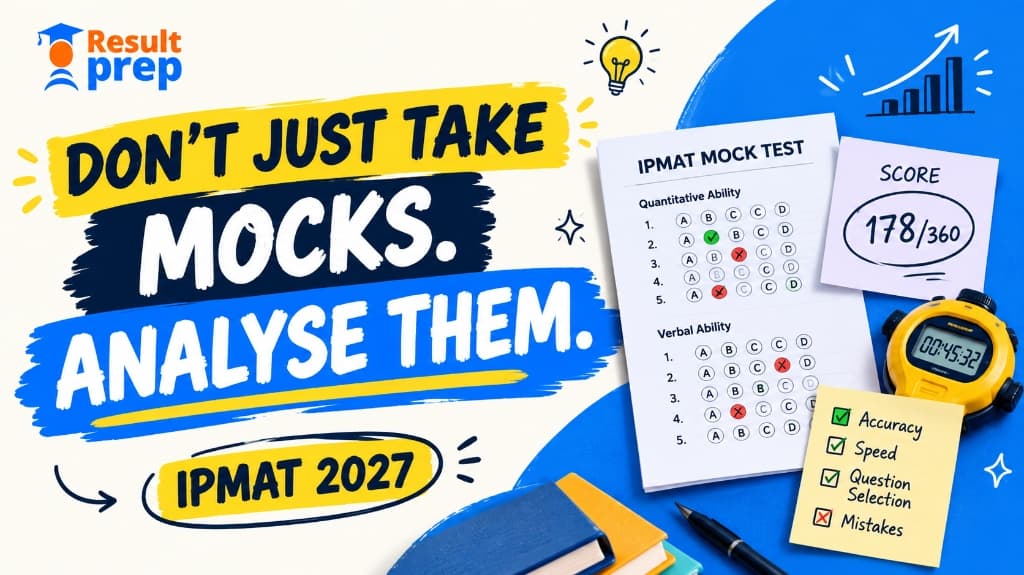
Taking an IPMAT mock test is easy. Knowing what to do after the mock is what actually transforms your score and gets you shortlisted for IIMs.
Many students finish a test, glance at their raw score, check the answer key, and immediately move on to the next mock. But your score only tells you what happened—it does not tell you why it happened.
For IPMAT 2027, mock tests are diagnostic tools designed to identify conceptual weak points, calibrate question selection, eliminate unforced errors, and master strict sectional time limits. Instead of asking only "What did I score?", begin asking:
"What can this mock teach me about my decision-making, accuracy, and time allocation under pressure?"
Why Is IPMAT Mock Test Analysis Important?
Suppose you score 180 in one mock and 205 in another. On paper, your score improved. But what if you:
- Guessed several Quant MCQs and got lucky?
- Left 6 straightforward algebra questions unattempted because of time mismanagement?
- Spent 8 minutes struggling with one complex permutation problem?
- Made 5 avoidable calculation errors in basic arithmetic?
- Scored higher simply because that specific paper was abnormally easy?
Raw scores cannot answer these questions. Systematic mock analysis breaks down your performance across four essential pillars: Accuracy, Speed, Question Selection, and Error Types.
The 7-Step IPMAT Mock Analysis Framework
Step 1: Check Section-Wise Performance First
In IPMAT (especially IIM Indore), high total marks mean nothing if you miss the sectional cutoff in Quantitative Ability (Short Answer), Quantitative Ability (MCQ), or Verbal Ability (MCQ).
Start by diagnosing which section is currently costing you the most marks or dragging you below sectional cutoffs:
- Is Verbal Ability highly accurate but eating too much reading time?
- Are Quant MCQs plagued with silly negative marks (-1 per wrong answer)?
- Are Quant SA (Short Answer) questions taking too long to compute without options?
Step 2: Classify Every Incorrect Question Into 5 Categories
Never simply mark a problem as "wrong." Diagnose the root cause:
| Error Type | What Happened? | Prescribed Fix |
|---|---|---|
| Conceptual Error | You didn't know the underlying mathematical theorem or grammatical rule. | Revise core theory and notes before attempting similar problems. |
| Calculation Error | Your approach was 100% correct, but an arithmetic slip cost you 5 marks (+4 lost, -1 penalty). | Practice mental math drills and write intermediate steps neatly. |
| Misread Question | You solved for x when the question asked for 2x + 1 or missed "except". | Underline the final target variable before writing the answer. |
| Time-Pressure Trap | You knew the formula but panicked under the countdown timer. | Practice 2-minute timed problem sets. |
| Blind Guessing | Gambled on an MCQ without eliminating at least 2 options. | Never guess blindly on MCQs with negative marking. |
Step 3: Analyze Questions You Left Unattempted
This is often where the highest score jumps hide. Review every skipped question and ask: "Could I have solved this if I saw it earlier?"
If you find 3 to 4 easy questions at the end of the section that you never even read, you have a Question Selection Problem, not a knowledge gap. Learn the art of the Two-Pass Strategy: solve easy sitters on Pass 1, and tackle moderate questions on Pass 2.
Step 4: Audit Time Spent Per Question
Two candidates can both score 12 correct answers in Quant. However, Candidate A solved them in 22 minutes (leaving 18 minutes for other questions), while Candidate B spent 38 minutes stuck on 3 questions. Audit your mock timer:
- Which questions consumed more than 2.5 minutes?
- Which problems should have been abandoned after 60 seconds?
Step 5: Re-Solve Wrong Questions Without Solutions
Before reading the official answer key, close the solutions and attempt the wrong questions in an untimed environment. If you solve it easily now, the mistake was caused by test anxiety or pacing. If you are still stuck, the issue is conceptual.
Step 6: Maintain an IPMAT Error Log
Maintain an error log tracking 4 items per mistake: Topic → What Went Wrong → Correct Approach → Immediate Action Item (e.g., "Percentages: used wrong base value → solve 15 mixed percentage problems").
Step 7: Track Multi-Mock Trends
Never panic over a single lower score. Mock difficulty fluctuates. Instead, track trends across 5 consecutive mocks: Is your accuracy staying above 85%? Are unforced errors decreasing? Are sectional scores balanced above historic IIM Indore cutoffs?
Sectional vs. Full-Length Mocks: How to Balance Both
- Sectional Mocks (40 mins): Best used on weekdays to aggressively fix weak topics (e.g., Higher Math / Permutations & Combinations / Reading Comprehension).
- Full-Length Mocks (120 mins): Best taken on weekends under strict exam conditions to train mental stamina and section-switching concentration.
"Don't take another mock just because you finished the previous one. Analyse the previous test first. Taking 30 mocks without analysis produces less improvement than taking 15 mocks and eliminating every single recurring error."
Prepare for IPMAT 2027 With ResultPrep
Targeting IIM Indore, IIM Rohtak, or IIFT? ResultPrep provides comprehensive offline classroom coaching in Bangalore covering Higher Math, Quantitative Aptitude, Verbal Ability, PI/WAT mentoring, and 1-on-1 mock analysis sessions.
Book a Free IPMAT Counselling Session
Meet our faculty in Bangalore to audit your mock scores, identify sectional bottlenecks, and build an IPMAT 2027 roadmap.
Book a Free Counselling SessionDiscussion (7)
Meghna Joshi
This is a very insightful article. The strategies mentioned are incredibly practical.
Aditya Singh
I've been preparing for a few months now and these tips perfectly align with what my mentors have been saying.
Divya Chatterjee
Do you have any offline batches starting soon? I need help with the advanced topics.
Rohan Patel
Bookmarked! I will be revisiting this guide before my mock tests next month.
Sneha Nair
The point about consistent daily practice cannot be overstated. Great read.
Tarun Mehta
Thank you for breaking down such a complex topic into actionable steps.
Ishita Rao
I shared this with my entire study group. We were making half the mistakes listed here.
Related Articles in IPMAT Preparation

IPMAT Cutoff 2027: Previous Year Cutoffs and What Score Should You Target?
Discover IPMAT 2027 cutoff expectations, previous-year cutoffs for IIM Indore and IIM Rohtak, sectional cutoff mechanics, target safe scores, and preparation strategies.

Can Non-Maths Students Crack IPMAT 2027? A Practical Preparation Guide
Can non-Maths and Commerce students crack IPMAT 2027? Discover how to build Quantitative Ability from scratch, a 4-step Quant plan, mistakes to avoid, and IIM eligibility realities.

IPMAT Personal Interview Questions 2027: What Should You Prepare For?
Clearing the IPMAT aptitude test is only half the battle. Discover the top 12 personal interview questions asked by IIM panels, how to prepare your profile, academics, hobbies, and avoid common PI traps.