Everything Students Should Know About the CLAT Exam Pattern and Syllabus
The complete guide to the CLAT 2027 exam pattern and syllabus: 120-question passage format, 5 sectional syllabi, marking scheme, offline OMR logistics, and preparation roadmaps.
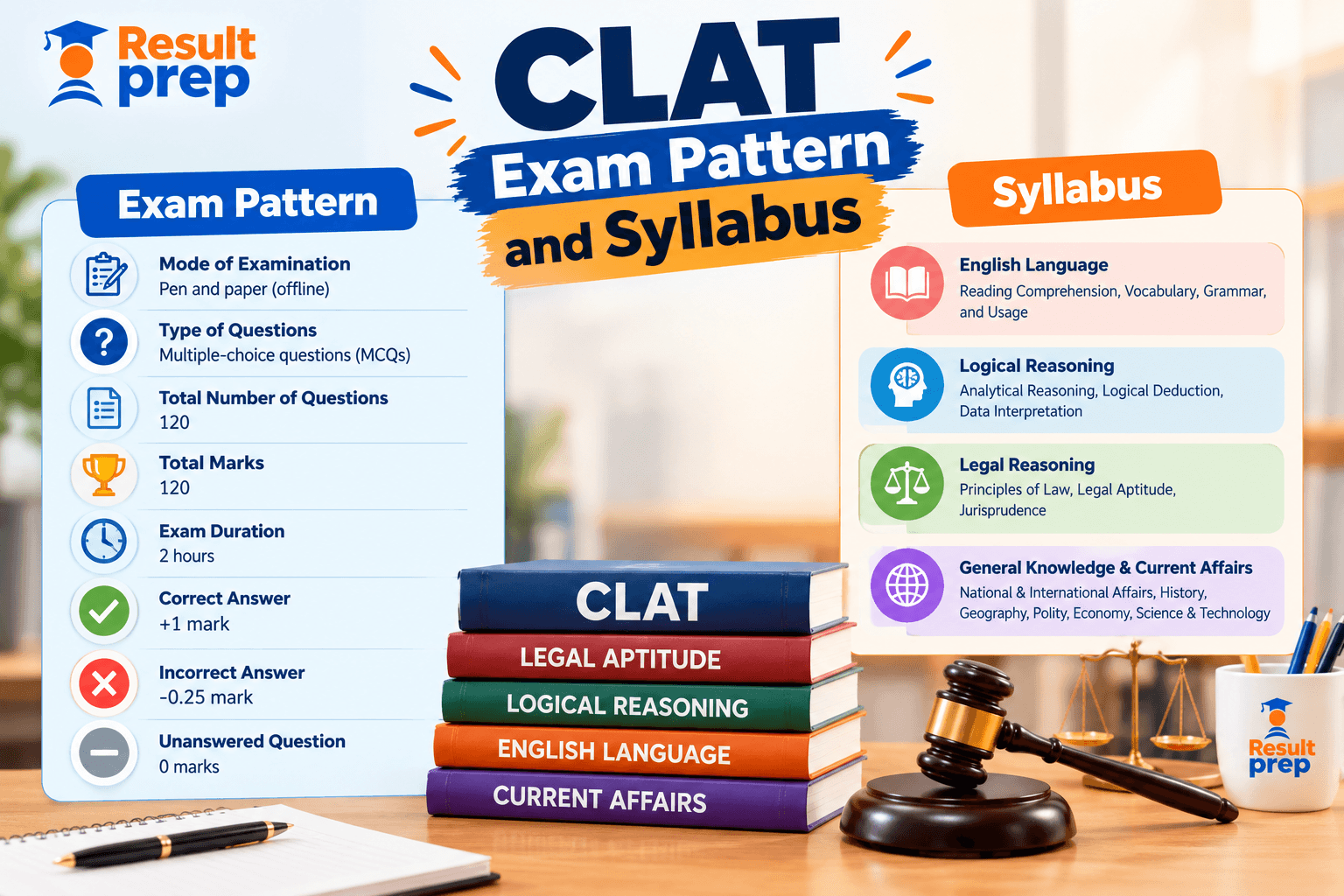
The Common Law Admission Test (CLAT) is India's most prestigious centralized entrance examination for aspiring legal scholars. Organized annually by the Consortium of National Law Universities (NLUs), CLAT serves as the premier admission gateway for five-year integrated undergraduate law programs (such as B.A. LL.B., B.B.A. LL.B., B.Com. LL.B., and B.Sc. LL.B.) and one-year postgraduate LL.M. degrees across 24 participating National Law Universities.
Cracking CLAT with an all-India top percentile requires far more than casual textbook reading—it demands a deep understanding of the exam's unique 100% passage-based architecture, sectional question distributions, negative marking mechanics, and time-budgeting strategies. This comprehensive guide breaks down the complete CLAT UG exam pattern, section-wise syllabus topics, scoring rules, and high-yield preparation blueprints.
Official CLAT UG Exam Pattern at a Glance
The CLAT UG exam tests candidates on reading comprehension, critical reasoning, legal evaluation, and numerical interpretation through 350-to-450-word passages followed by a series of multiple-choice questions:
| Exam Characteristic | Official Specification |
|---|---|
| Mode of Examination | Offline (Pen-and-Paper based with OMR Sheet) |
| Question Format | Passage-Based Multiple Choice Questions (MCQs) |
| Total Questions | 120 Questions |
| Total Marks | 120 Marks |
| Duration | 2 Hours (120 Minutes) |
| Marking Scheme | +1 Mark for each correct answer |
| Negative Marking | -0.25 Marks for each incorrect answer |
| Unanswered Questions | 0 Marks (No penalty) |
Section-by-Section Syllabus Breakdown (CLAT UG)
1. English Language (~24 Questions / ~20% Weightage)
This section evaluates reading comprehension, vocabulary in context, grammar syntax, and critical deconstruction of authorial arguments derived from contemporary or historical fiction and non-fiction passages (approx. 450 words each):
- Identifying the main idea, central argument, and supporting evidence.
- Inferring the author’s tone, perspective, and hidden implications.
- Contextual vocabulary and idiomatic interpretations.
- Contrasting arguments within complex textual paragraphs.
2. Current Affairs & General Knowledge (~30 Questions / ~25% Weightage)
Passages are sourced from news broadcasts, journalistic articles, government press releases, and non-fiction commentaries:
- Major contemporary events in national governance and public policy.
- International affairs, bilateral treaties, and multilateral summits (G20, UN, BRICS).
- Landmark judicial pronouncements, constitutional amendments, and legal milestones.
- Historical context and background facts associated with breaking news events.
3. Legal Reasoning (~30 Questions / ~25% Weightage)
Candidates read 450-word passages discussing legal scenarios, ethical dilemmas, or constitutional questions:
- Identifying statutory principles, common-law rules, and ethical duties.
- Applying given legal principles strictly to new factual circumstances.
- Evaluating how modifications in factual variables alter legal liability.
- Note: Prior legal training is not required; external legal bias must be excluded.
4. Logical Reasoning (~24 Questions / ~20% Weightage)
Critical reasoning passages test logical validity, argumentation structures, and inferential validity:
- Deconstructing premises, underlying assumptions, and final conclusions.
- Strengthening and weakening arguments with additional evidence.
- Detecting logical fallacies, contradictions, and circular reasoning.
- Evaluating cause-and-effect relationships and analogical inferences.
5. Quantitative Techniques (~12 Questions / ~10% Weightage)
Short caselets, numerical passages, charts, and tables testing foundational 10th-grade arithmetic:
- Data Interpretation (tables, bar charts, caselets, line graphs).
- Percentages, profit and loss, simple and compound interest.
- Ratios, proportions, averages, time-speed-distance, and work calculations.
CLAT PG Exam Pattern Overview
For candidates pursuing an LL.M. degree, the CLAT PG paper consists of 120 objective questions testing comprehension of extracts from primary legal sources: judgments, statues, and academic legal literature. Key subjects include Constitutional Law, Jurisprudence, Administrative Law, Law of Contract, Torts, Family Law, Criminal Law, Property Law, Company Law, and Public International Law.
A Proven 7-Step CLAT Preparation Strategy
- 1. Deconstruct the Official Syllabus: Print the official bulletin and classify topics into Strong, Moderate, and Weak buckets.
- 2. Build Daily Reading Stamina: Read 2 opinion editorials daily from The Hindu or The Indian Express to build rapid comprehension across 15,000 words.
- 3. Maintain a Spaced Current Affairs Binder: Synthesize monthly legal and national developments rather than hoarding unread PDFs.
- 4. Practice Strict Principle-Fact Application: When solving Legal Reasoning, treat the passage's stated legal principle as sovereign truth.
- 5. Enforce 60-Second Question Triage: Answer sitters immediately, skip time-traps, and manage OMR bubbling time.
- 6. Audit Every Mock Exam: Log careless mistakes, blind guesses, and conceptual errors into an active Mistake Notebook.
- 7. Partner with Experienced Mentors: Guided coaching helps demystify tricky passages and provides authentic mock analytics.
ResultPrep: Premier Law Entrance Mentorship in Bangalore
For law aspirants in Bengaluru, ResultPrep provides comprehensive classroom coaching in Vidyaranyapura, Bengaluru. With small batch sizes, seasoned entrance faculty, passage deconstruction labs, computer-based mock analytics, and personalized mentoring, ResultPrep empowers students to achieve top NLU percentiles. Visit ResultPrep.com to explore batch schedules.
Conclusion
Mastering the CLAT exam pattern and syllabus is the foundation of high-scoring preparation. By understanding the passage-based architecture, practicing strict principle application, maintaining daily reading discipline, and auditing every mock error, you can approach the CLAT with supreme confidence and secure your seat at India's top National Law Universities.
Discussion (7)
Vikram Iyer
This is a very insightful article. The strategies mentioned are incredibly practical.
Kavya Bose
I've been preparing for a few months now and these tips perfectly align with what my mentors have been saying.
Rahul Verma
Do you have any offline batches starting soon? I need help with the advanced topics.
Simran Gupta
Bookmarked! I will be revisiting this guide before my mock tests next month.
Manish Mathur
The point about consistent daily practice cannot be overstated. Great read.
Priya Sharma
Thank you for breaking down such a complex topic into actionable steps.
Siddharth Kapoor
I shared this with my entire study group. We were making half the mistakes listed here.
Related Articles in CLAT Preparation
CLAT - Criteria for Eligibility: Age Range, Criteria, and Prerequisites
A complete guide to CLAT 2027 eligibility: Minimum marks in Class 12, no age limit rules, stream flexibility, reservation categories, and CLAT UG vs. PG comparison.

How to Apply for CLAT: A Step-By-Step Guide For Law Aspirants
A complete walkthrough of the CLAT application process: Step-by-step registration on the Consortium portal, document specifications, fee payment, common pitfalls, and post-submission steps.
Preparing for the CLAT: A How-To Guide to Begin Your Journey into Law School
A comprehensive beginner's roadmap to kickstart CLAT preparation: Master all 5 passage-based sections, establish daily reading habits, build an error-free revision routine, and avoid common prep pitfalls.