How to Prepare Current Affairs and GK for CLAT & Law Entrances
Learn how to filter daily newspapers, compile notes, and memorize static facts for the CLAT Current Affairs and GK section.

In the highly volatile ecosystem of the Common Law Admission Test (CLAT) and elite Law Entrance Examinations, the Current Affairs & General Knowledge section stands as the ultimate rank-decider. It constitutes 25% of the entire examination, yet it is the only section that can be completed in under 12 minutes. This creates a massive time-arbitrage opportunity: students who dominate GK instantly unlock 20 extra minutes to invest in the time-consuming Legal and Logical Reasoning sections. However, the tragedy of CLAT GK preparation is that 90% of students are studying for an exam that no longer exists. They spend hundreds of hours memorizing isolated, one-liner facts from massive monthly PDFs, attempting to memorize the names of obscure CEOs or minor sports trophies. Since its structural shift, the CLAT Consortium has aggressively punished this rote-memorization approach. Modern CLAT GK is heavily passage-based, designed explicitly to test your "Contextual and Peripheral Knowledge." If a passage is about the G20 Summit, the questions will not ask who hosted it. They will ask about the historical foundation of the G20 in 1999, the specific geopolitical treaties related to it, or the constitutional provisions regarding international relations. To secure a Top 100 NLU rank, you must abandon the "Daily News" mindset and transition to a highly analytical "Issue-Based Tracking Framework." This massive, 1500-word blueprint deconstructs the exact methodologies used by top percentilers to filter the noise, extract peripheral data, and permanently memorize the immense volume of CLAT Current Affairs.
Phase 1: The Anatomy of a CLAT GK Passage
To master CLAT Current Affairs, you must first reverse-engineer the examiner's psychology. When a CLAT paper setter selects a passage from The Hindu or The Economist, they are not testing your awareness of the headline; they are testing your awareness of the entire ecosystem surrounding that headline. This is known as the "360-Degree Peripheral Rule."
The 4-Dimensional Extraction Method
Whenever a major national or international event occurs, you must research it across four distinct dimensions:
- 1. The Factual Core: What exactly happened, who are the primary stakeholders, and what is the immediate outcome?
- 2. The Historical Timeline: When did this issue first originate? (e.g., If the issue is the Uniform Civil Code, you must trace it back to the Constituent Assembly debates).
- 3. The Legal & Constitutional Angle: This is the most heavily tested dimension. What specific Articles of the Indian Constitution, Supreme Court judgments, or international treaties govern this issue?
- 4. The Geographical Matrix: Where is this happening? If it is a geopolitical conflict, you must know the bordering countries, the relevant straits, and the major rivers involved.
Phase 2: The Issue-Based Tracking Framework
The traditional method of writing down daily current affairs linearly in a physical notebook is mathematically destined to fail. If you write notes chronologically (Day 1, Day 2, Day 3), your information becomes entirely fragmented. The Israel-Palestine conflict will have one paragraph on page 4, another on page 17, and another on page 45. When revision time comes, you will not be able to connect the dots.
Creating the "Second Brain"
You must digitize your preparation using hierarchical software like Notion, Evernote, or Microsoft OneNote. You must organize your entire GK syllabus into 7 Core Buckets: International Relations, National Polity, Legal & Supreme Court Judgments, Economics, Science & Tech, Environment, and Miscellany (Awards/Sports).
Instead of creating daily notes, you create an "Issue Page." For example, create a master page titled "The Crisis in the Red Sea." Whenever a new development occurs regarding this issue over the next 6 months, you simply open this master page and add the new information to the bottom. By the end of the year, you will have 60 to 70 highly comprehensive "Master Issue Documents" that read exactly like Wikipedia pages. When a passage on the Red Sea appears in the exam, your brain will instantly recall the entire chronological sequence because you studied it as a single, cohesive story.
Phase 3: The Source Hierarchy Strategy
The single biggest cause of anxiety for law aspirants is "Fear Of Missing Out" (FOMO). Students hoard 5 different newspapers and 10 different monthly compendiums, leading to catastrophic cognitive overload. You must establish a strict hierarchy of information sources and stick to it religiously.
The Primary Source: The Daily Newspaper
You must read either The Hindu or The Indian Express daily for exactly 45 to 60 minutes. Your objective while reading the newspaper is NOT to memorize facts. Your objective is "Issue Identification." The newspaper tells you what is important. It builds your reading speed and your vocabulary. Skip the local city news, the Bollywood gossip, and the micro-political bickering. Focus exclusively on the Editorial page, the National page, and the International page.
The Secondary Source: Premium Compendiums
Because the newspaper only provides the daily update, it often lacks the historical and peripheral facts required for CLAT. This is where you use a premium monthly compendium (like the ones provided by top-tier coaching institutes or UPSC magazines like VisionIAS). Use these compendiums strictly for "Peripheral Fact Extraction." At the end of the month, cross-reference the compendium with your digital "Issue Pages" and fill in the missing historical or legal gaps.
Phase 4: The Reverse-Engineering Mock Protocol
Mock tests are the most underutilized tool for GK preparation. Most students take a mock test, check their GK score, feel depressed, and move on. This is a massive waste of resources. CLAT mocks are meticulously designed by experts who spend hours identifying the most highly probable exam topics.
The Post-Mock Extraction
You must treat every mock test as a customized syllabus generator. If a mock test features a passage on the "Anti-Defection Law" and you score 0/5 on it, you must not just look at the answer key. You must immediately create a new "Issue Page" for the Anti-Defection Law in your digital notes. You must research its origin (52nd Amendment), the relevant schedule (10th Schedule), and recent Supreme Court judgments (e.g., Kihoto Hollohan). By reverse-engineering 40 mock tests throughout the year, you will organically build an impenetrable fortress of knowledge covering the 200 most important topics of the year.
The Sunday Consolidation Ritual
Current Affairs is a rapidly decaying asset. Information that is vital in April might become completely irrelevant by October. To prevent your notes from becoming a bloated, unreadable mess, you must execute a strict "Sunday Consolidation Ritual." Dedicate two hours every Sunday exclusively to auditing your digital notes. Merge redundant information, delete minor updates that didn't evolve into major issues, and actively quiz yourself on the historical dimensions of your core buckets. By applying this ruthless, systematic framework to your GK preparation, you eliminate the unpredictability of the section, transforming CLAT Current Affairs into a massive, highly calculated mathematical advantage.
Discussion (7)
Rohan Das
How do you memorize the specific Article numbers related to current events?
Anjali Verma
I am transferring all my 7 Core Buckets to Evernote tonight.
Simran Kaur
The Source Hierarchy cleared my FOMO. One newspaper + One Compendium. That's it.
Rahul Verma
Using mocks strictly for Reverse-Engineering 'what I don't know' rather than checking my score is a huge mindset shift.
Aman Gupta
I finally stopped trying to read both The Hindu and The Indian Express daily.
Nikhil Joshi
Is VisionIAS overkill for CLAT, or is it exactly the level of depth required?
Priya Sharma
The 360-Degree Peripheral Extraction is the only way to survive CLAT GK now. Headlines are useless.
Related Articles in CLAT Preparation
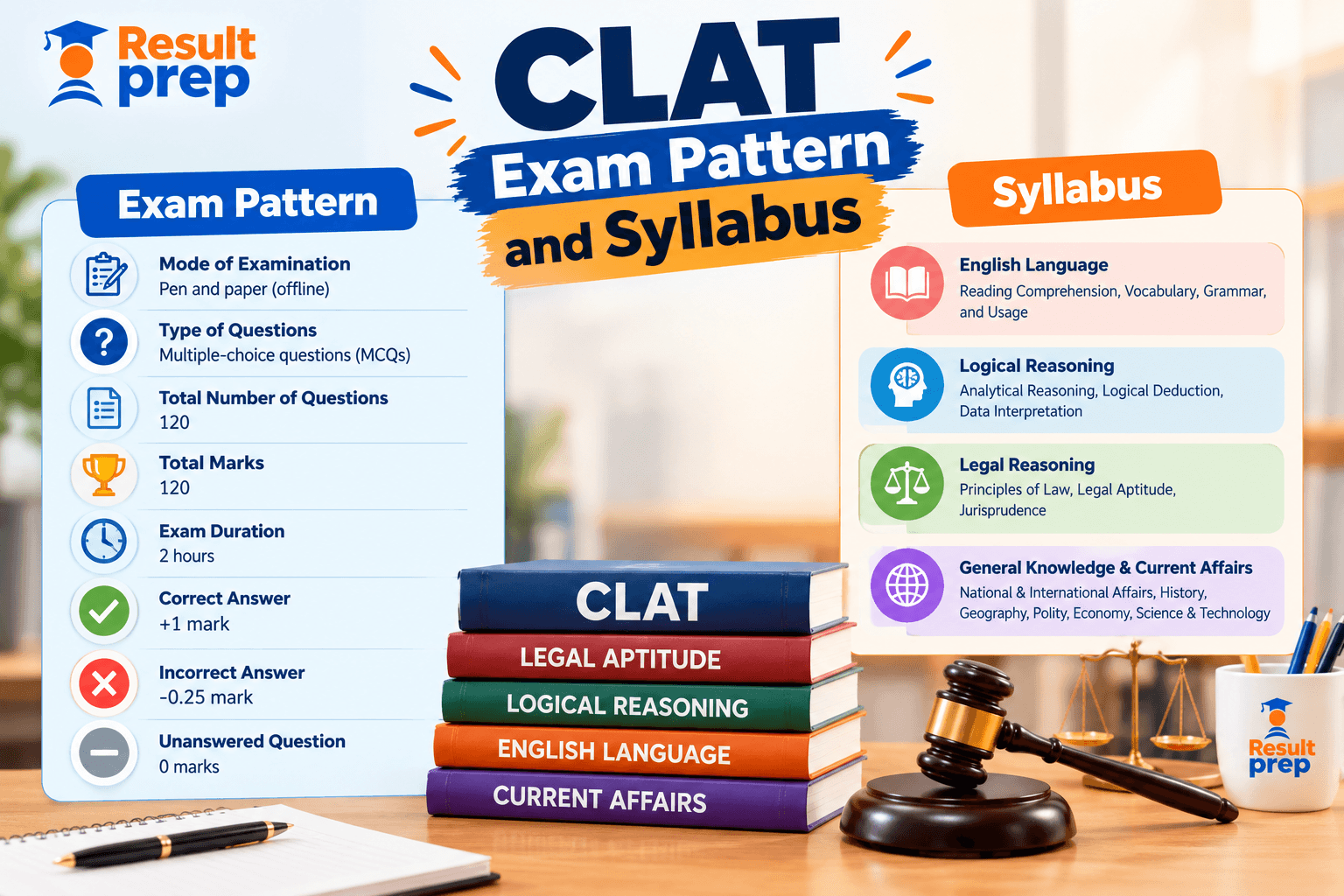
Everything Students Should Know About the CLAT Exam Pattern and Syllabus
The complete guide to the CLAT 2027 exam pattern and syllabus: 120-question passage format, 5 sectional syllabi, marking scheme, offline OMR logistics, and preparation roadmaps.
CLAT - Criteria for Eligibility: Age Range, Criteria, and Prerequisites
A complete guide to CLAT 2027 eligibility: Minimum marks in Class 12, no age limit rules, stream flexibility, reservation categories, and CLAT UG vs. PG comparison.

How to Apply for CLAT: A Step-By-Step Guide For Law Aspirants
A complete walkthrough of the CLAT application process: Step-by-step registration on the Consortium portal, document specifications, fee payment, common pitfalls, and post-submission steps.