Cracking the IPMAT Code: A Fresh Blueprint for Your IIM Journey
Stepping straight from high school into an IIM? Discover a practical blueprint for IPMAT Indore, Rohtak, and JIPMAT covering Quant, Verbal, mock analysis, and board exam balance.

Stepping out of high school and straight into a premier management institution like an IIM sounds like a plot from an overachiever's playbook. Yet, with the Integrated Programme in Management Aptitude Test (IPMAT), thousands of students turn this ambitious vision into reality every year.
If you are staring at a mountain of formulas, grammar guides, and mock test schedules wondering where to begin, take a deep breath. Success in this exam isn't about studying harder or pulling endless all-nighters; it's about shifting your mindset from rote memorization to pure problem-solving agility.
"IPMAT is not an audition of how much you can memorize; it is an assessment of how quickly and accurately your mind evaluates patterns, eliminates bad choices, and performs under intense clock pressure."
1. Understand Your Battleground (The Exam DNA)
Before opening a single textbook, familiarize yourself with what you are up against. Exams like IPMAT Indore, IPMAT Rohtak, and JIPMAT evaluate more than just academic knowledge—they test endurance, decision-making, and structural speed under severe pressure.
| Section | Question Formats | Core Competencies Tested |
|---|---|---|
| Quantitative Ability (QA) | Short Answer (SA - Non-MCQ) & Multiple Choice (MCQ) | Demands razor-sharp calculation speed and conceptual depth in higher-level math (Calculus, Matrices, Combinatorics) alongside foundational arithmetic. |
| Verbal Ability (VA) | Multiple Choice Questions | Goes far beyond basic school grammar. Evaluates reading intuition, context comprehension, vocabulary under constraints, and logical paragraph sequencing. |
| Logical Reasoning (LR) | Multiple Choice Questions (Prominent in Rohtak & JIPMAT) | Evaluates how neatly and swiftly you can untangle complex data patterns, arrangements, syllogisms, and series under strict clocks. |
2. Build a Foundation: Concept Over Shortcuts
One of the most common pitfalls for aspirants is chasing shortcut tricks before mastering the underlying principles.
For Quantitative Ability
Treat your Class 11 and 12 NCERT mathematics textbooks as your primary foundation for calculus, algebra, functions, and matrices, while treating middle-school arithmetic as the bedrock for calculation speed. Instead of blindly mugging up shortcut formulas, understand why a formula works. If a question is twisted creatively on test day, your conceptual clarity will be what saves your score.
For Verbal Ability
Cultivate a genuine, consistent reading habit. Dive into opinion columns, long-form essays, and varied literature from sources like Aeon, The Hindu, or The Economist. When you read diverse material daily, Reading Comprehension (RC) stops feeling like a chore and starts feeling like an engaging intellectual conversation.
Keep an Error Journal
The Error Journal Habit:
Every single time you get a practice question wrong, write down why in a dedicated notebook. Was it a conceptual gap, a misread sentence, or a calculation slip? Tracking your blunders is the single fastest way to stop repeating them.
3. The Art of Smart Mock Testing
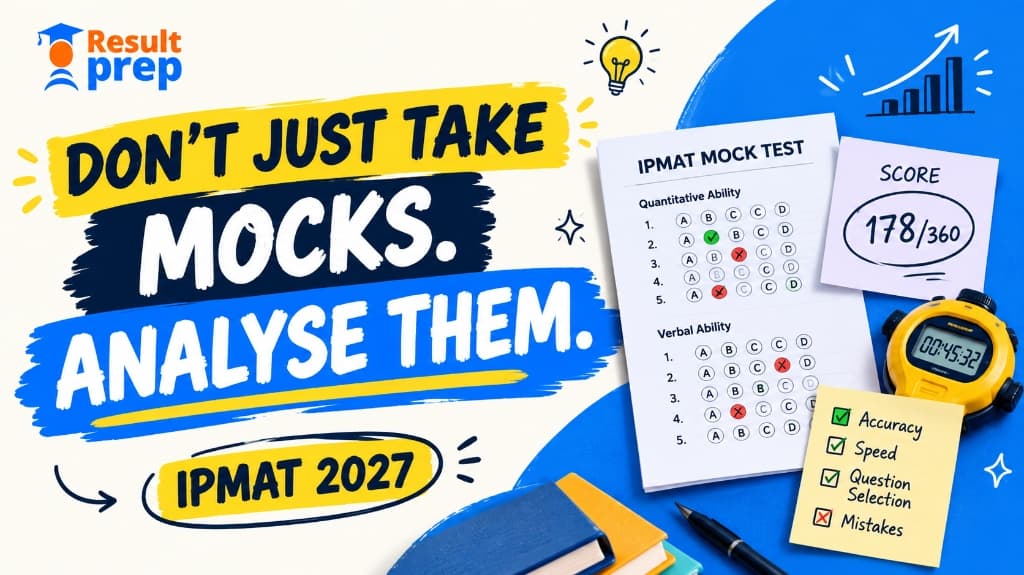
Mock tests are not just evaluation tools; they are training grounds where you forge your exam temperament. Writing a mock without analyzing it is equivalent to running on a treadmill—you sweat a lot, but you go nowhere.
- Phase 1 (Topic-Wise Tests): Once you wrap up individual topics (like Percentages, Modern Math, or Para-jumbles), take targeted mini-quizzes to lock in your learnings and build topical confidence.
- Phase 2 (Full-Length Mocks): Introduce full-scale simulations mid-way through your preparation cycle to experience sectional time limits and fatigue management.
- The Post-Mortem Routine: Spend twice as much time analyzing a mock as you did taking it. Look for recurring patterns: Are you spending too much time on ego-driven math questions? Are you panicking when the verbal section gets dense? Adjust your pacing and question selection accordingly.
4. Balancing School Boards and IPMAT
Since IPMAT targets students right out of Class 12, striking a balance between school board performance and competitive aptitude prep is critical.
The good news? There is massive syllabus overlap. Your school mathematics and English grammar form the core of your IPMAT preparation. Instead of treating them as two separate worlds, blend them. Dedicate consistent, non-negotiable blocks of time—say, two focused hours every evening—exclusively for aptitude concepts, keeping daytime school hours for board fundamentals.
Final Thoughts
Cracking IPMAT is a marathon fueled by consistency rather than a 100-meter sprint. There will be weeks when mocks humble you and concepts feel slippery. That is entirely normal. Stay adaptable, protect your mental stamina, and trust the compounding effect of daily practice.
Frequently Asked Questions (FAQs)
When is the ideal time to start preparing for IPMAT?
Starting by Class 11 gives you an ideal runway to build foundational strength without burning out. However, dedicated aspirants who begin in Class 12 can also crack it with a rigorous, high-focus daily schedule.
Is higher mathematics mandatory for IPMAT Indore?
While IPMAT Indore's quantitative section includes Class 11 and 12 mathematics topics (like calculus, matrices, and permutation-combination), students from non-math backgrounds can clear it with structured coaching, disciplined practice, and a strong grip on fundamental concepts.
How many mock tests should I take before the actual exam?
Aim for at least 25 to 30 full-length mocks. Quality trumps quantity, however—deeply analyzing 15 mocks yields better results than rushing through 50 without reviewing your mistakes.
Can I manage IPMAT preparation alongside my CBSE/State board exams?
Absolutely. Because a significant portion of the IPMAT syllabus overlaps with school-level mathematics and English, you can leverage your board studies while reserving dedicated evening slots for aptitude-style problem solving.
Discussion (7)
Tarun Mehta
This is a very insightful article. The strategies mentioned are incredibly practical.
Sneha Nair
I've been preparing for a few months now and these tips perfectly align with what my mentors have been saying.
Rohan Patel
Do you have any offline batches starting soon? I need help with the advanced topics.
Divya Chatterjee
Bookmarked! I will be revisiting this guide before my mock tests next month.
Aditya Singh
The point about consistent daily practice cannot be overstated. Great read.
Meghna Joshi
Thank you for breaking down such a complex topic into actionable steps.
Amit Desai
I shared this with my entire study group. We were making half the mistakes listed here.
Related Articles in IPMAT Preparation

Which Colleges Accept IPMAT Scores in 2027? IIMs and Other Institutes
IPMAT opens doors far beyond IIM Indore. Explore all IIMs and top business schools accepting IPMAT Indore, Rohtak, and JIPMAT scores in 2027, including IIFT, NALSAR, TAPMI, and Nirma.

IPMAT Exam Day Strategy 2027: How to Manage Time, Questions and Exam Pressure
Preparation alone isn't enough on exam day. Learn proven strategies for IPMAT 2027: sectional time allocation, 3-tier question triage, handling tough sections, and exam-hall psychology.
How to Analyse IPMAT Mock Tests: A Step-by-Step Strategy for IPMAT 2027
Taking an IPMAT mock is easy; knowing how to analyse it is what gets you into IIMs. Learn the 7-step analysis framework, error classification, and sectional time optimization.