CLAT Legal Reasoning Secrets: How to Score 30+ in Legal Aptitude
Uncover the secret techniques NLU toppers use to read legal passages, apply principles to facts, and score high in Legal Reasoning.
Welcome to the definitive manual for cracking the most vital and complex section of the entire law entrance spectrum: CLAT Legal Reasoning Secrets: How to Score 30+ in Legal Aptitude. If your objective is securing a seat at a Tier-1 institution like NLSIU Bangalore or NALSAR Hyderabad, you must approach the Legal Reasoning section with surgical precision. Unlike traditional high-school civics or rote-memorization exams, CLAT Legal Reasoning is a grueling high-speed evaluation that screens for elite reading comprehension and advanced logical deduction. This guide dismantles the complexities of the legal aptitude section and provides a rigorous, data-driven framework to elevate your score beyond the 30-mark threshold.
Decoding the Legal Reasoning Gauntlet: The Comprehension Architecture
The modern CLAT represents a massive paradigm shift in Indian legal entrances. Because top-tier NLUs hold the undisputed titles of premier undergraduate institutions, their testing metrics are ruthlessly competitive and fundamentally opposed to rote learning logic. The challenge is split into two distinct, interconnected components: The Dense Passage Extractor and The Principle-Fact Applicator.
The Dense Passage Extractor Gatekeeper
The passage acts as the baseline academic filter. It is an intensive, subjective 450-word evaluation testing your ability to read complex legal jargon, constitutional debates, or recent Supreme Court judgments under extreme pressure. Crucially, your reading speed is often a minimum eligibility criteria for even finishing the paper, but conceptual clarity is psychologically vital for high accuracy. Aspirants often make the fatal error of either entirely abandoning active reading—leading to them missing the core legal principle—or over-investing in understanding every single word, completely burning their clock. The Consortium structure demands that you extract the exact legal rule elegantly, logically, and expansively, which is the exact opposite of what casual reading demands.
The Principle-Fact Applicator Gauntlet
This is where your career is truly won or lost. The questions following the passage demand structured, high-speed objective reasoning without the safety net of your own outside knowledge. You are not expected to know the Indian Penal Code; you are tested on how logically you can read the provided legal rule, apply it to a completely hypothetical (and often absurd) factual scenario, and derive exact answers under extreme time pressure. A student accustomed to applying their own moral compass or real-world logic must suddenly pivot to applying a strict, rigid framework in under 60 seconds.
Strategic Legal Aptitude Methodologies
Clearing the 30+ mark hurdle requires abandoning generic reading habits. You must transition into a highly disciplined, outcome-oriented preparation protocol that balances reading stamina with raw analytical application.
"The Legal Reasoning section does not merely test your knowledge of law; it tests your capacity for high-stress objective application. Mastering the Principle-Fact mapping framework is non-negotiable."
Mastering the Strict-Application Framework
To dominate the reasoning questions, you must adopt the Strict Application (Factual Override) method. This framework forces your reasoning into a highly structured, unyielding routine that prevents "outside knowledge bleed"—the rapid shifting of legal concepts from the real world into the examiner's hypothetical universe. First, clearly state the core principle from the passage. Next, assume the principle is absolute, undeniable truth (even if it states that murder is legal on Tuesdays). Then, allocate completely separate mental blocks for mapping those rules exactly to the facts. Finally, deliver total, unambiguous focus within the options by eliminating any choice that introduces facts not stated in the passage. This allows you to bypass the mental fatigue of trying to judge the morality of a situation.
Structuring High-Scoring Reading Habits
Your daily reading schedule evaluates your raw processing power over long durations. Slow, unplanned reading will be heavily penalized by the 120-minute CLAT time limit. Your routines must feature sharp editorial analysis, instantaneous shifting between complex legal topics, and a balanced, pragmatic approach to vocabulary building. Practice reading The Hindu editorials daily: Monday, Wednesday, and Friday dedicated 70% to purely legal judgments, while Tuesday, Thursday, and Saturday are dedicated 70% to sociological and economic opinions. Sundays are reserved exclusively for full-length reading comprehension mock tests and deep error analysis to lend immense strategic clarity to your week.
The Critical Role of the Mock Analysis Pivot
Given the rigorous demands of managing 120 questions across five sections, timeline management within the Legal section is your greatest adversary. Taking official, full-length CLAT Mocks must be carefully timed. You must condition yourself to execute the "Legal Pivot." Allocate exactly 35 minutes to the Legal Reasoning section. If you hit the 35-minute mark, pivot your attention to the remaining sections, regardless of how many questions are left. For aspirants struggling to coordinate these dual requirements, enrolling in structured Legal Reasoning Sectional Tests can provide the curated materials and expert feedback necessary to optimize this pivot without completely losing touch with reading speeds. You must also leverage your analysis efficiently; spend two hours reviewing why a legal option was wrong so your underlying logical frameworks are entirely protected.
Psychological Endurance and Moral Separation
Perhaps the most overlooked element of preparing for CLAT Legal Reasoning is the immense cognitive load it places on a student's moral compass. The human brain is naturally designed to seek justice and fairness. Therefore, strategic emotional detachment is just as vital as strategic studying. You must strictly enforce a "mechanical logic" mindset. Sacrificing logical application to side with an emotionally sympathetic victim in a fact-scenario destroys your neural pathways' ability to objectively apply the rules, crippling your performance.
Ultimately, dominating the CLAT Legal Reasoning section requires immense discipline, psychological resilience, and a willingness to embrace extreme academic rigor. By following this comprehensive blueprint, you are not just preparing for a single section—you are laying the elite intellectual and organizational foundation required for a highly successful, multi-faceted corporate legal career. The capacity to handle intense, parallel logic is precisely what top National Law Universities are testing for. Embrace the gauntlet, execute your reading blocks flawlessly, and victory is assured.
Discussion (7)
Ishita Chatterjee
This is a very insightful article. The strategies mentioned are incredibly practical.
Karan Patel
I've been preparing for a few months now and these tips perfectly align with what my mentors have been saying.
Anjali Nair
Do you have any offline batches starting soon? I need help with the advanced topics.
Siddharth Mehta
Bookmarked! I will be revisiting this guide before my mock tests next month.
Priya Rao
The point about consistent daily practice cannot be overstated. Great read.
Manish Das
Thank you for breaking down such a complex topic into actionable steps.
Simran Reddy
I shared this with my entire study group. We were making half the mistakes listed here.
Related Articles in CLAT Preparation
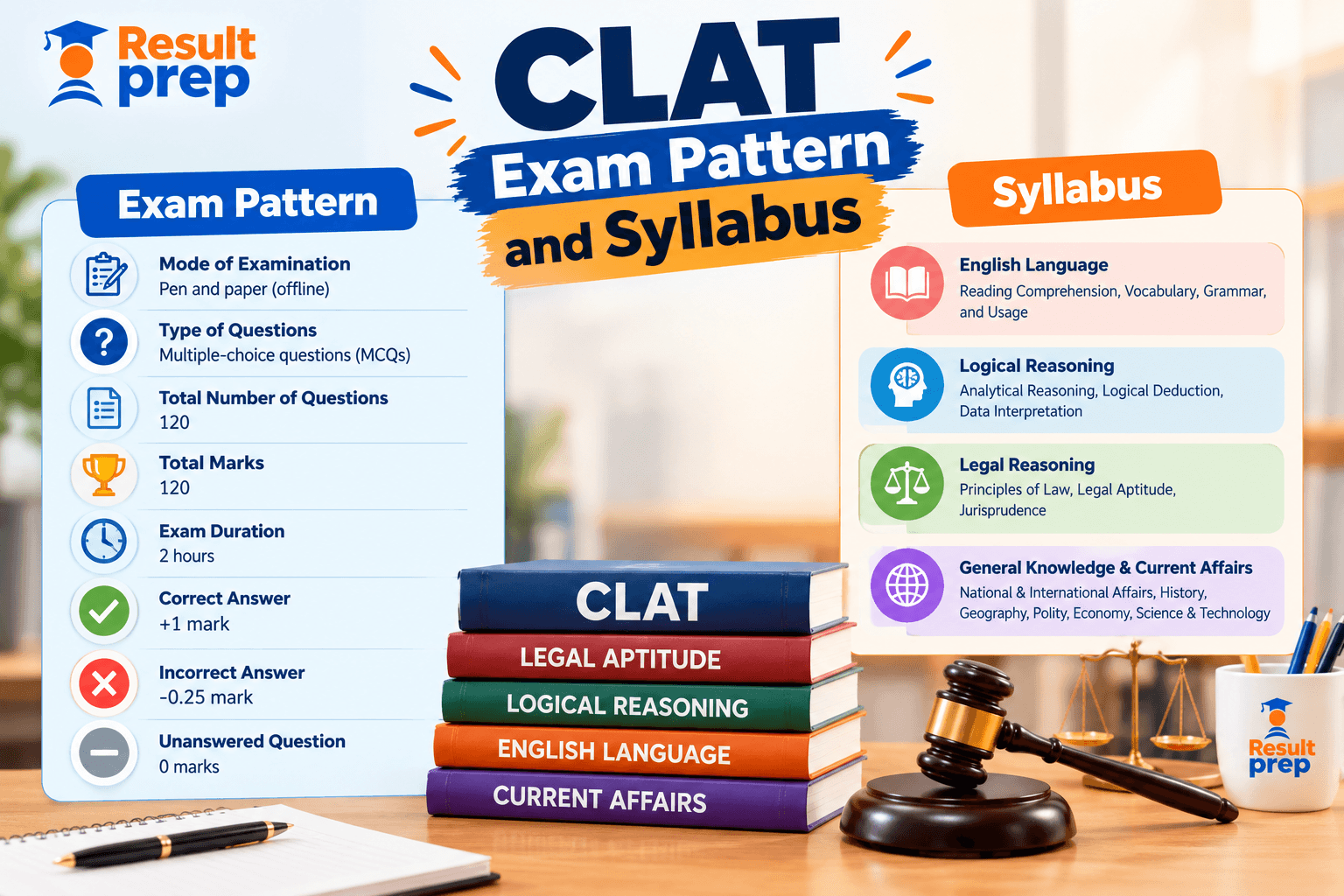
Everything Students Should Know About the CLAT Exam Pattern and Syllabus
The complete guide to the CLAT 2027 exam pattern and syllabus: 120-question passage format, 5 sectional syllabi, marking scheme, offline OMR logistics, and preparation roadmaps.

CLAT - Criteria for Eligibility: Age Range, Criteria, and Prerequisites
A complete guide to CLAT 2027 eligibility: Minimum marks in Class 12, no age limit rules, stream flexibility, reservation categories, and CLAT UG vs. PG comparison.

How to Apply for CLAT: A Step-By-Step Guide For Law Aspirants
A complete walkthrough of the CLAT application process: Step-by-step registration on the Consortium portal, document specifications, fee payment, common pitfalls, and post-submission steps.