Complete CLAT Preparation Strategy: A Month-by-Month Guide to NLU Admissions
Master the art of CLAT preparation with our comprehensive roadmap covering logical reasoning, legal aptitude, vocabulary, and mock analysis.

Welcome to the ultimate, definitive manual for cracking the upcoming law entrance exams: the CLAT 2025 Comprehensive Strategy. As the competition for the top National Law Universities (NLUs) reaches unprecedented heights, relying on outdated preparation methods or superficial rote learning is a guaranteed path to failure. The Common Law Admission Test (CLAT) is no longer an examination of what facts you have memorized; it is a grueling, 120-minute cognitive marathon that ruthlessly tests your reading endurance, contextual analysis, and high-pressure decision-making skills. This exhaustive, master-level guide dismantles the modern CLAT syllabus layer by layer and provides a surgical, data-driven framework designed specifically to catapult you into the top 1% of NLU admissions.
Decoding the CLAT 2025 Structural Matrix
Before launching into daily preparation routines and buying stacks of preparatory books, serious aspirants must fully understand the architecture of the examination they are facing. The Consortium of NLUs has aggressively shifted the exam pattern towards pure comprehension-based assessment. You are confronted with massive, dense blocks of text across five distinct subjects: English Language, Current Affairs (including General Knowledge), Legal Reasoning, Logical Reasoning, and Quantitative Techniques. Every single question requires extracting data from a dense passage under extreme time constraints.
The challenge is not the difficulty of the individual questions, but the sheer volume of reading required. A typical CLAT paper contains over 15,000 words. Processing this volume, comprehending the nuance, and making accurate logical deductions in just 120 minutes requires a fundamentally different approach to studying than what Indian high school board exams demand.
"The modern CLAT does not test what legal facts you know; it tests how fast you can process new, unfamiliar information and logically apply it. Your greatest asset is not your memory, but your reading speed and cognitive stamina."
Legal Reasoning: The Core Engine of NLU Admissions
The Legal Reasoning section is the absolute cornerstone of your CLAT preparation strategy. Carrying immense weightage, this section evaluates your ability to digest complex legal principles—drawn from Torts, Contracts, Criminal Law, Constitutional Law, and International Law—and apply them strictly to convoluted, often intentionally misleading factual matrices.
The most common, fatal error students make is relying on their pre-existing legal knowledge or their internal moral compass. The cardinal rule of CLAT Legal Reasoning is absolute obedience to the passage. If the passage states a mathematically absurd or morally flawed legal principle, you must treat it as absolute truth for the scope of the question. To master this section, you must systematically practice "Principle-Fact mapping." You must learn to isolate the exact, specific conditions required to trigger a rule, and ruthlessly verify if the fact scenario satisfies every single one of those conditions.
Furthermore, reading landmark Supreme Court judgments and understanding the evolution of basic legal doctrines will immensely speed up your reading comprehension in this section. When you are already familiar with the vocabulary of a legal text, your brain spends less time decoding the language and more time analyzing the logic.
Logical Reasoning: Cognitive Speed and Pattern Recognition
Logical Reasoning in CLAT acts as a severe filter for elite critical thinking. Unlike traditional analytical puzzles (like blood relations or complex seating arrangements), this section is now heavily dominated by Critical Reasoning. You will be asked to identify core premises, intermediate conclusions, assumptions, and logical flaws within complex argumentative texts drawn from opinion editorials, philosophical essays, and economic reports.
To dominate this section, you must reprogram how you read. Stop reading for mere information and start reading for structural architecture. Ask yourself constantly while reading: What is the author ultimately trying to prove? What exact evidence are they using to support this claim? What unstated assumptions are holding their argument together? When you can accurately map argument structures within 45 seconds, your accuracy will skyrocket. Regular practice with high-quality, GMAT-level critical reasoning modules can provide a massive competitive advantage here, as the question formats are structurally identical.
The Silent Rank Deciders: English, GK, and Quants
While Legal and Logical reasoning form the backbone of the exam, the remaining three sections dictate whether you secure a Tier-1 NLU like NLSIU Bangalore or NALSAR Hyderabad, or whether you drop out of the selection list entirely.
English Comprehension: Surviving the Reading Marathon
English Language is the silent rank decider. It requires you to parse complex editorial pieces, historical narratives, scientific journals, and philosophical treatises. The key to this section is vocabulary in context and understanding tone. You must deduce the meaning of esoteric words based purely on the surrounding sentences. We strongly recommend reading the editorial sections of The Hindu or The Indian Express for at least 45 minutes daily. This is not just for vocabulary; this builds the ocular stamina required to survive the 120-minute reading marathon without your brain shutting down from fatigue.
Current Affairs & General Knowledge: Beyond Rote Memorization
Current Affairs is the most time-efficient section of the paper, often allowing students to secure 25 marks in under 10 minutes. However, passive reading of monthly compilation magazines is highly ineffective for the modern CLAT. The Consortium frequently tests the historical context, statistical background, and legal ramifications of contemporary events. If a major constitutional amendment is passed, do not just memorize the date and the article number; study the preceding Supreme Court judgments that led to it, the parliamentary debates surrounding it, and its socio-economic impact.
Active recall, daily quiz rounds, and structured note-making are essential. Group your notes into thematic, interconnected categories such as International Relations, Macroeconomics, Space & Technology, and Landmark Legal Developments. This thematic grouping helps your brain retrieve information much faster during the exam.
Quantitative Techniques: The 10% Advantage
Thousands of law aspirants suffer from severe math phobia and abandon the Quantitative Techniques section entirely. This is a catastrophic strategic mistake. The 10-15 marks available in this Data Interpretation section can literally jump your rank by 500 to 1000 positions. The mathematics tested is strictly up to the Class 10 level—focusing heavily on percentages, ratios, averages, and basic geometry applied to tabular data, pie charts, and bar graphs.
By dedicating just 30 to 45 minutes a day to practicing Data Interpretation sets, you can easily secure 80% accuracy in a section that a vast majority of your competitors will leave completely blank. Do not sacrifice these easy marks out of fear; mastering basic calculation speed is all it takes to dominate this section.
Structuring the Ultimate Month-by-Month CLAT Timeline
A brilliant strategy is useless without rigorous, disciplined execution. Consistency will beat raw talent every single time in this exam. Here is a proven, phase-based timeline to structure your upcoming year of preparation:
- Phase 1: Foundation and Concept Building (Months 1-4) - Focus entirely on understanding core legal theories, critical reasoning fundamentals, and basic mathematical formulas. Build your reading speed to at least 250-300 words per minute. Create your GK note-making systems. Do not worry about your mock test scores during this phase; focus purely on accuracy and conceptual clarity.
- Phase 2: Sectional Mastery and GK Consolidation (Months 5-8) - Begin aggressive sectional testing. Identify which specific question types (e.g., 'Weakening the Argument' in Logical Reasoning or 'Torts' in Legal Aptitude) are tanking your overall accuracy. Drill these weak areas mercilessly. This is also when your backlog of Current Affairs must be systematically revised using active recall techniques.
- Phase 3: The Mock Test Marathon (Months 9-12) - Your daily routine must shift heavily toward taking full-length CLAT mock tests. Write at least two mocks a week under strict exam conditions (exactly from 2 PM to 4 PM to align with your circadian rhythm). Build your exam temperament and finalize your section-attempting order.
The Exact Science of Mock Test Analysis
Taking a mock test without deeply analyzing it afterward is a complete waste of two hours. Deep mock analysis is the ultimate secret weapon of top 100 rankers. After every single test, you must spend at least three hours dissecting your performance line by line.
Categorize your errors into three distinct buckets:
- Knowledge Deficits: You simply did not know the legal concept or the GK fact. Fix this by adding it to your notes.
- Reading Errors: You knew the concept, but you missed a crucial "NOT", "EXCEPT", or "INCORRECT" in the question stem, or you misread a critical line in the passage. Fix this by practicing mindful reading and highlighting keywords.
- Temporal Errors: You rushed the final section due to immense time pressure, leading to wild guessing. Fix this by strictly enforcing time limits per section (e.g., 35 minutes for Legal, 25 minutes for Logical).
By aggressively patching these specific micro-flaws after every mock, your percentile will steadily climb into the 99th bracket. Remember, you do not learn from taking the mock; you learn from analyzing your mistakes.
Psychological Resilience on Exam Day
Finally, we must address the psychology of the exam. CLAT is designed to induce panic. You will inevitably encounter a passage that makes absolutely no sense, or a GK section filled with obscure facts you have never seen. Your ability to remain calm, skip the paralyzing questions, and relentlessly hunt for the easier questions is what separates the winners from the rest.
Ultimately, cracking CLAT 2025 requires immense discipline, psychological resilience, and a willingness to embrace extreme academic rigor. By following this comprehensive, highly structured blueprint, you are not just preparing to clear an entrance exam—you are laying the elite intellectual foundation required for a highly successful, lifelong career in the legal profession.
Discussion (7)
Manish Das
The breakdown of Principle-Fact mapping is brilliant. I always used to apply my own outside knowledge and lose marks.
Aman Gupta
How early should we start the 'Mock Test Marathon'? Is it okay if my scores are low during the first few mocks?
Shruti Desai
The focus on reading stamina over pure speed is something my coaching institute never mentioned.
Divya Singh
Are offline mocks strictly better than online mocks for CLAT simulation?
Preeti Singh
Math phobia is real! Thank you for emphasizing the 10% advantage in quantitative techniques. I'm going to start practicing DI sets daily.
Anjali Verma
The advice on categorizing mock test errors into Knowledge, Reading, and Temporal buckets is a total game changer.
Vikram Mehta
This is easily the most structured CLAT guide I have read. Pinning this page to my browser for the next year!
Related Articles in CLAT Preparation
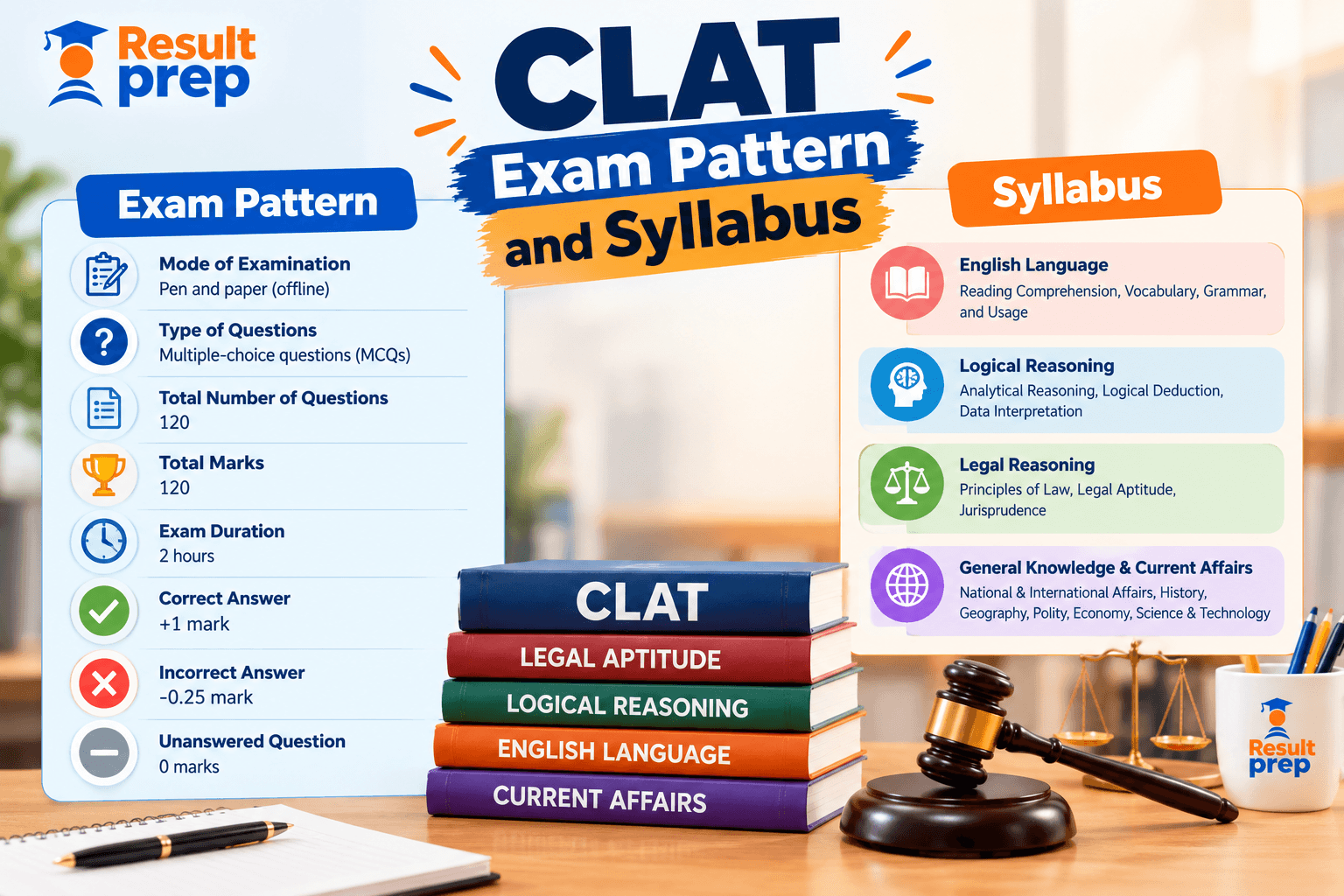
Everything Students Should Know About the CLAT Exam Pattern and Syllabus
The complete guide to the CLAT 2027 exam pattern and syllabus: 120-question passage format, 5 sectional syllabi, marking scheme, offline OMR logistics, and preparation roadmaps.

CLAT - Criteria for Eligibility: Age Range, Criteria, and Prerequisites
A complete guide to CLAT 2027 eligibility: Minimum marks in Class 12, no age limit rules, stream flexibility, reservation categories, and CLAT UG vs. PG comparison.

How to Apply for CLAT: A Step-By-Step Guide For Law Aspirants
A complete walkthrough of the CLAT application process: Step-by-step registration on the Consortium portal, document specifications, fee payment, common pitfalls, and post-submission steps.