Best Newspapers for Competitive Exams & How to Read Them
A student guide comparing The Hindu vs Indian Express vs LiveMint, and step-by-step instructions on what sections to read and ignore.
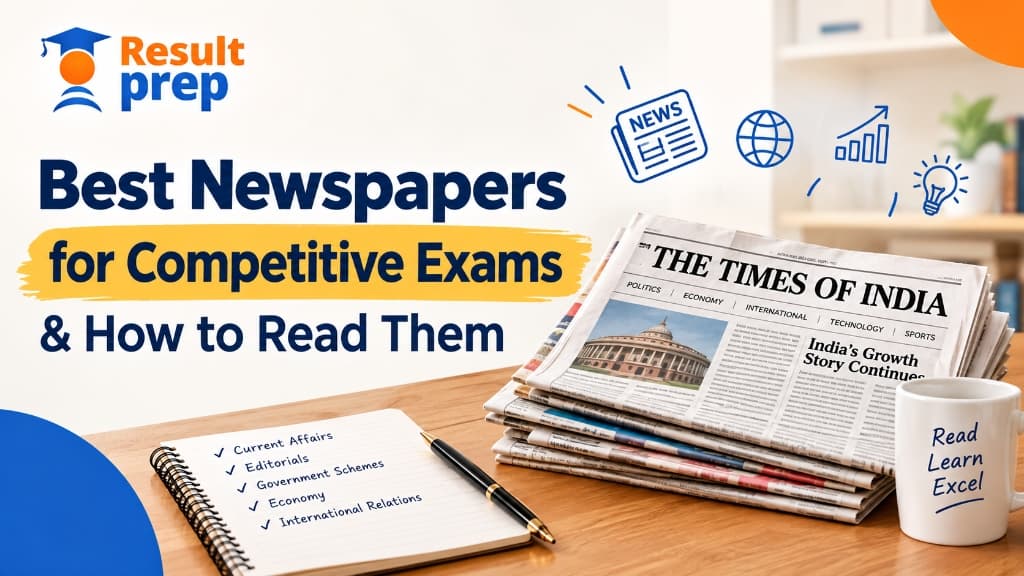
In the high-stakes arena of competitive examinations like CLAT, IPMAT, and CUET, success is rarely determined by how many textbooks you have memorized. Instead, the modern testing paradigm heavily favors cognitive agility, rapid reading speed, and profound contextual awareness. There is one tool—and only one tool—that simultaneously builds all three of these pillars: the daily newspaper. Unfortunately, the vast majority of aspirants use this tool incorrectly. They spend three hours passively reading front-page political gossip, treating the paper like a novel rather than a strategic resource. This comprehensive, 1500-word masterclass will deconstruct exactly which newspapers you should choose, what specific sections you must read (and ignore), and how to deploy the "Active Reading Method" to extract maximum value in under 45 minutes a day.
The Titans of Print: Choosing Your Weapon
Not all newspapers are created equal. Local dailies or tabloid-style papers are entirely useless for national-level entrance exams. Your choice of newspaper dictates the quality of vocabulary, the complexity of grammatical syntax, and the depth of current affairs you are exposed to daily. You must choose from the "Big Three."
The Hindu: The Gold Standard for CLAT and UPSC
The Hindu is universally revered as the holy grail for law entrance and civil service aspirants. Its editorial standards are legendary. The language used in its Op-Ed section is dense, formal, and often abstract—precisely the kind of prose you will encounter in the CLAT Reading Comprehension and Legal Aptitude sections. Furthermore, its coverage of landmark Supreme Court judgments, constitutional debates, and international relations is unmatched in its depth. If you are aiming for a Tier-1 NLU, The Hindu is your mandatory daily companion.
The Indian Express: The Balanced Alternative
If you find the language of The Hindu excessively archaic or intimidating to start with, The Indian Express (IE) is the perfect alternative. IE is famous for its "Explained" section, which breaks down complex geopolitical events, economic policies, and legal issues into easily digestible, highly structured articles. This section is an absolute goldmine for building foundational General Knowledge. The vocabulary is slightly more accessible, making it an excellent starting point for Class 11 students before graduating to denser texts.
LiveMint: The Corporate Playbook for IPMAT
For aspirants targeting the IIMs via the IPMAT, the focus shifts. IIM entrance exams feature reading comprehension passages heavily skewed toward macroeconomics, corporate philosophy, and financial markets. LiveMint (often partnered with The Wall Street Journal) is the undisputed champion here. Reading Mint daily acclimatizes your brain to corporate jargon, financial logic, and business ethics. It is the exact tone and style of writing you will face in the IPMAT Verbal Ability section.
The Art of Active Reading
The single greatest mistake an aspirant can make is reading the newspaper passively. Your brain must be engaged in high-speed data extraction.
"Reading a newspaper for an entrance exam is an aggressive act. You are not reading for entertainment; you are reading to mine factual data, map logical arguments, and absorb high-level structural syntax."
Active reading involves holding a pen (or a digital highlighter) and constantly interrogating the text. When you read an editorial, you must subconsciously ask yourself: What is the author's primary premise? What evidence are they using to support this premise? Is their tone objective, cynical, or cautiously optimistic? This mental conditioning directly translates into higher accuracy in inference-based Reading Comprehension questions.
What to Read (and What to Ignore)
A standard broadsheet contains roughly 20 pages. If you try to read everything, you will waste 3 hours of your precious study time. You must learn the art of ruthless omission. Your daily newspaper reading should be a surgical strike, not a meandering walk.
The "Ignore" List: Absolute Time-Wasters
You must strictly avoid the following sections, as they yield zero return on investment for competitive exams:
- City/Local News: Burglaries, traffic updates, or local municipal disputes are never tested.
- Political Gossip: "Who said what to whom" at a political rally is irrelevant. Only policy decisions matter.
- Entertainment & Bollywood: Gossip columns offer no vocabulary enhancement and zero GK value.
- Pure Sports Commentary: While major sports awards (like the Olympics or World Cup winners) are important for GK, day-to-day match commentaries are a waste of time.
The "Must-Read" List: The High-Yield Zones
Focus 100% of your energy on these specific pages:
- The Front Page (5 Minutes): Skim the headlines to grasp the 3 or 4 major national or international events of the day. Do not read the full articles unless it's a major constitutional or macroeconomic development.
- The Editorial and Op-Ed Pages (25 Minutes): This is the heart of your preparation. Read the two main editorials published by the newspaper staff, and pick one major opinion piece written by a guest expert (usually a diplomat, economist, or legal scholar). This is where you build reading speed, vocabulary, and argument-mapping skills.
- The National/International News (10 Minutes): Look specifically for major policy launches, international treaties, geopolitical conflicts, and significant Supreme Court rulings.
- The Business/Economy Page (5 Minutes): For IPMAT aspirants, this is crucial. Track inflation trends, RBI policy rate changes, and major corporate mergers.
The 45-Minute Daily Blueprint
To ensure you do not burn out, restrict your newspaper reading to a strict 45-minute window. We highly recommend completing this in the morning, as reading complex editorials requires a fresh, unfatigued brain.
Minutes 0-10: The Broad Skim
Scan the front page, national, and international pages. Mentally note down 3 major events that seem important for current affairs.
Minutes 10-35: The Deep Editorial Dive
Turn to the editorial page. Read actively. Do not stop at every difficult word to check the dictionary—this breaks your reading momentum and ruins your speed. Instead, circle the difficult words and try to deduce their meaning from the context of the sentence (a critical skill for IPMAT and CLAT).
Minutes 35-45: The Extraction Protocol
Now, open your dictionary and check the exact meanings of the words you circled. Write them down in a dedicated Vocabulary Log. Next, synthesize the main point of the editorial into a single bullet point in your Current Affairs notes.
Integrating Newspaper Prep with GK and English
Your newspaper reading should feed directly into your broader study systems. Create two digital documents (using Notion, Evernote, or Google Docs):
1. The Contextual Vocabulary Log
Never write down just the word and its meaning. Always write down the complete sentence in which the newspaper used the word. Understanding how a word is deployed in formal syntax is far more important than knowing its isolated definition. Review this log every Sunday.
2. The Issue-Based GK Tracker
Instead of noting down daily trivia, organize your General Knowledge notes by "Issues." If you read an article about the Israel-Palestine conflict today, create a page for it. Tomorrow, if there is another article on the same topic, add bullet points to that existing page. By the end of the year, you will have comprehensive, chronological dossiers on every major global issue, making revision incredibly easy.
Overcoming the 'Boring' Factor
Let’s be honest: for a 17-year-old student, reading a dense editorial on fiscal deficit policy or constitutional law is incredibly boring. However, competitive exams do not care about your entertainment. The ability to force your brain to focus on dry, abstract, and complex texts is exactly what these exams are testing. Treat the boredom as a workout for your cognitive endurance. Just as a marathon runner pushes through physical pain, you must push through the mental friction of complex reading.
Mastering the daily newspaper is the ultimate force multiplier in your preparation. It simultaneously transforms you into a speed-reader, a vocabulary expert, and a current affairs authority. Execute the 45-minute active reading blueprint with relentless consistency, and you will secure an unassailable advantage over the competition.
Discussion (7)
Pooja Kumar
The 45-minute strict limit is essential. I used to fall down a rabbit hole of reading international news for 3 hours.
Amit Patel
I struggle with the highly dense economic jargon in LiveMint. Any tips on bridging the gap?
Ravi Teja
The tip about skipping sports and Bollywood gossip is obvious but I needed to hear it.
Kavya Menon
Does anyone actually make physical notes from newspapers anymore? Digital seems so much faster.
Priya Sharma
Is The Indian Express 'Explained' section sufficient for the deep-dive historical context?
Siddharth Rao
I was reading Times of India for 2 hours every day and getting zero value for CLAT. Switched to The Hindu Editorial.
Sneha Reddy
The Economist is too expensive. Can I rely solely on the Indian Express for high-level vocabulary?
Related Articles in Study Skills & Productivity
How to Improve Reading Comprehension for Entrance Exams
Struggling with dense passages, tricky inferences, and time pressure in CLAT, IPMAT, or CUET? Discover paragraph-mapping frameworks, option-elimination tactics, and daily reading habits to master RC.

How to Stop Phone Distractions While Studying: Practical Tips for Students
Losing hours of study time to Instagram Reels, YouTube Shorts, and endless notifications? Learn practical, science-backed strategies to tame digital distractions and reclaim your focus.

How to Deal With Exam Stress: Practical Ways to Stay Calm and Focused
Overwhelmed by exam anxiety, parental pressure, or mock test results? Discover evidence-based mental frameworks, daily routines, and stress management tools to stay composed and perform your best.